
radiating pain treatment
Radiating Pain Treatment: How to Choose the Right Next Discussion

Start with the clinical question and the outcome
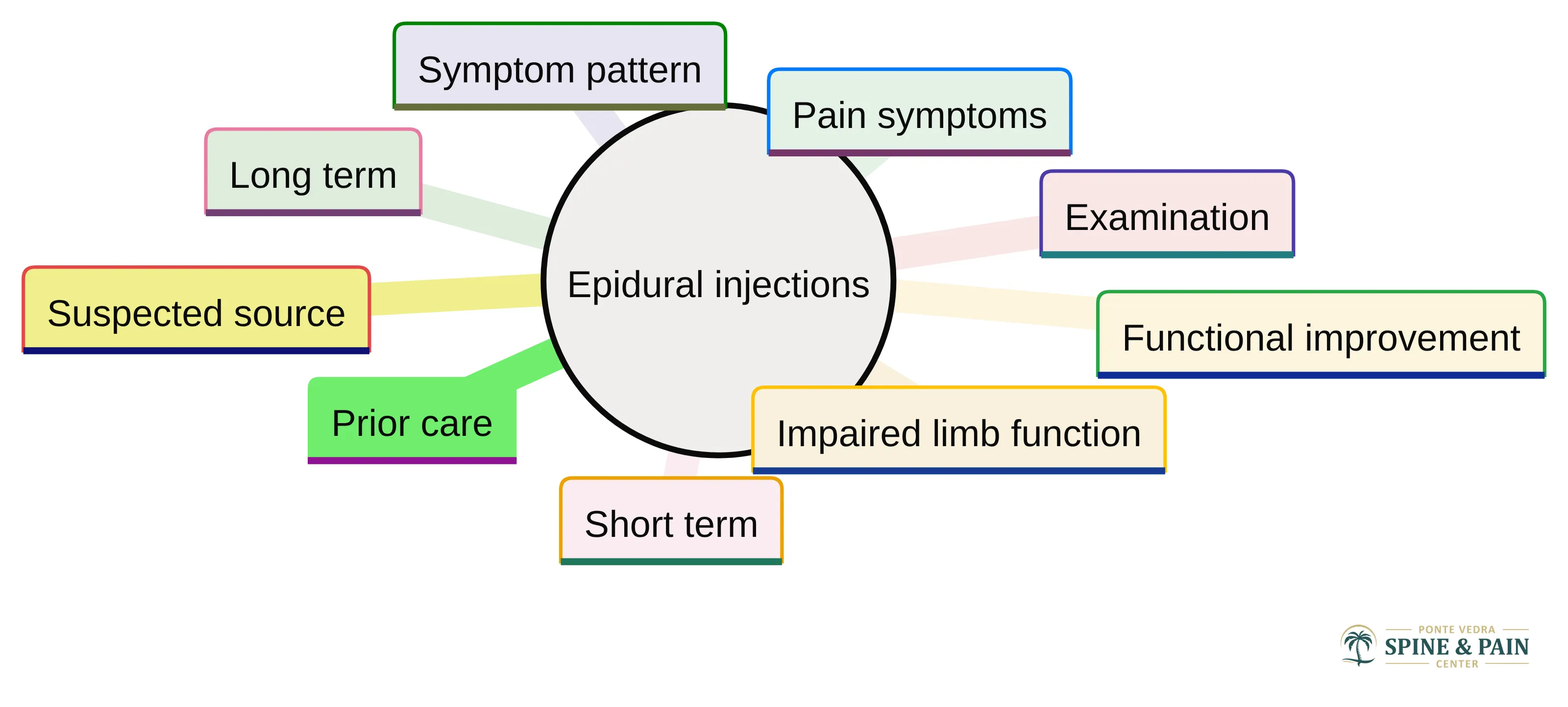
Radiating pain treatment should begin with an evaluation of your symptoms, examination findings, and possible source—not with a procedure name. A focused comparison separates the clinical question from the outcome being assessed: an option may be discussed for pain, function, or both, and those outcomes should not be treated as interchangeable. In a review of epidural steroid injections, the included studies found a significant reduction in pain symptoms but no statistical short- or long-term functional improvement. That contrast gives you a focused way to ask what an option is intended to address before discussing whether it fits.
Radiating pain can have several causes. A scan may show a disc change, but that finding does not establish that the disc is causing your symptoms. Clinicians interpret your history, physical findings, and imaging together. Radiculopathy means symptoms caused by a pinched spinal nerve root. Depending on its location, it can involve pain, weakness, numbness, or tingling.
At Ponte Vedra Spine & Pain Center, we offer image-guided injections, radiofrequency ablation, nerve stimulation, and regenerative therapy. Those categories describe what we offer; they do not determine what fits your situation. Before discussing any option, ask what clinical question it is meant to answer and what finding would change the plan.
A focused treatment conversation starts with four questions:
- What symptom pattern is the proposed option meant to address?
- Which examination finding or suspected source makes it relevant?
- How do duration, severity, functional effect, and prior care affect the discussion?
- What new information would lead the clinician to reassess it?
These questions keep the conversation tied to your case without assuming a diagnosis or promising a result.
What can a treatment discussion about radiating pain establish?
Sciatica can have more than one possible source. Possibilities include spinal stenosis, a slipped vertebra, arthritis that narrows the exit canal, or compression farther down in the buttock. Radiating pain in the lower leg can also reflect different conditions, so symptoms should not be used to label a lumbar disc problem by themselves. The diagnosis should bring together your medical history, examination, and any imaging that is relevant to the decision.
At Ponte Vedra Spine & Pain Center, we use pain management options that include image-guided injections, nerve stimulation, radiofrequency ablation, and regenerative therapy. The presence of a radiating pattern may explain why a nerve-focused discussion is appropriate, but it does not show which option, if any, should be considered.
Some radiculopathy symptoms improve on their own in a few days or weeks, while others need evaluation and treatment. That possible course should be kept separate from urgent warning signs. New bladder problems or altered sensation in the saddle area can be warning signs of cauda equina syndrome. Seek emergency care if these symptoms are present. At Ponte Vedra Spine & Pain Center, we recommend being seen if sciatica isn’t improving, if you have weakness, or if the pain is severe enough that waiting it out isn’t reasonable.
Separate routine treatment planning from warning signs
Bladder changes can include new difficulty starting urination, dribbling, incomplete emptying, loss of bladder fullness sensation, or loss of control. Altered saddle-area sensation includes a new change in feeling around the area that contacts a saddle. Seek emergency care if these symptoms are present.
Ponte Vedra Spine & Pain Center offers nerve-focused options such as nerve stimulation and radiofrequency ablation for treatment discussions that are appropriate after evaluation. These routine categories are separate from emergency warning signs. Do not use a routine pain-management appointment as a substitute for emergency care when new bladder problems or altered saddle-area sensation are present.
How can pain and function evidence sharpen treatment discussions?
Radiating pain treatment discussions should separate the outcome being considered: pain symptoms, physical function, source localization, or the need for more evaluation. That distinction matters because evidence about pain does not automatically establish an improvement in function. One review found a significant reduction in pain symptoms in the included studies of epidural steroid injections, but no statistical functional improvement in the short or long term. The review also said more analysis was needed for people with impaired limb function. This does not determine what is appropriate for an individual. It gives the discussion a more precise starting point: name the outcome, identify the clinical question, and ask what information supports considering the option now. A procedure name alone cannot answer those questions.
Imaging is useful when its result is likely to change management. NICE guidance says imaging is not routinely recommended in non-specialist care for low back pain or sciatica, while specialist care may consider it when the result could influence treatment. That guidance comes from the United Kingdom, so it should be understood as general clinical guidance rather than an individualized instruction for your care.
A scan also needs clinical context. CT or MRI can show disc herniations in 20% to 36% of people without symptoms or sciatica. For that reason, imaging findings should correspond with your symptoms and examination findings before they are treated as the explanation for your pain.
That process keeps the target under discussion. A nerve-root finding on an image is not enough by itself if the side, level, or symptom pattern does not match.
Before discussing a procedure, ask what information supports discussing it now and which important questions remain unanswered. Ask whether the proposed option is meant to clarify a suspected source, address a symptom pattern, or fit into a broader plan. The procedure name alone cannot answer those questions. To test whether a proposed target is coherent, keep three statements separate: the symptom statement—where pain travels and what sensory or strength changes accompany it; the clinical finding—what history or examination finding supports a suspected source; and the decision statement—what the proposed option is meant to address and what result would change the plan. This structure does not diagnose the cause. It exposes where uncertainty remains. An image may show a disc change, but the discussion still needs to explain how that finding relates to the symptom route and examination. If that relationship is unclear, ask whether the next step is further evaluation, observation, or a treatment discussion with a different stated purpose. The point is not to demand a procedure or reject one. It is to keep the source question, the treatment role, and the outcome being assessed from collapsing into a single label such as radiating pain. This is especially useful when comparing an injection or nerve block with nerve stimulation, radiofrequency ablation, or regenerative therapy, because availability of a category does not resolve the clinical question.
When can conservative care be part of the plan?
If sciatica isn’t improving, you have weakness, or the pain is severe enough that waiting it out isn’t reasonable, we recommend being seen. Treatment depends on the type and severity of radiculopathy, and some symptoms improve on their own in a few days or weeks. That possibility does not mean persistent or function-limiting pain should be ignored. Use the course of the symptoms as a reassessment point, not as a verdict about which treatment is needed. When symptoms are improving, the discussion may remain focused on simpler support and observation. When symptoms persist, worsen, or continue to interfere with function, the reason to reassess is stronger because the expected course has become less clear. Weakness or pain severe enough that waiting is not reasonable also changes the discussion, without identifying a diagnosis by itself.
This comparison has limits in both directions. Conservative care does not answer every question about the source of radiating pain, particularly when symptoms continue or the clinical picture remains uncertain. A more involved option is not automatically the next step, either. The clinician still needs to connect an injection, nerve block, nerve stimulation, radiofrequency ablation, or regenerative therapy to the symptom pattern, examination, suspected source, and prior care. The useful decision is therefore whether the current plan still fits the course of the symptoms, what new information is needed, and what finding would support reassessment.
NICE guidance recommends matching support to risk. Simpler support may be used for low back pain with or without sciatica when improvement is likely, while more complex or intensive support may be considered when the risk of a poor outcome is higher. The useful question is not whether conservative care is universally right or wrong. It is whether the expected course, symptom severity, and effect on function support that level of care.
At Ponte Vedra Spine & Pain Center, we offer image-guided injections, nerve stimulation, radiofrequency ablation, and regenerative therapy when those categories are appropriate to discuss. Their availability does not mean you need a procedure. If symptoms are improving, the next discussion may remain focused on observation and support; if they persist or interfere with function, an evaluation can identify whether a different level of care should be considered.
If you are considering a more involved option, ask how it relates to your symptom pattern, examination findings, duration, severity, functional effect, and response to earlier care. That question helps distinguish a reasoned escalation from a decision based only on the name of a treatment.
What question do image-guided injections and nerve blocks address?
Image-guided injections and nerve blocks should be discussed in relation to a suspected target, not as one interchangeable treatment category. At Ponte Vedra Spine & Pain Center, our image-guided injections include epidural injections, facet and medial branch blocks, joint injections, and nerve blocks placed under live X-ray or ultrasound. The type of injection identifies the category of target being discussed, but it does not establish that the target is causing your pain.
Use the category name as a prompt for a more specific conversation:
- Epidural injection: Ask what part of your symptom pattern, examination, or imaging makes an epidural discussion relevant.
- Facet or medial branch block: Ask what findings make this category worth considering and what question the block is intended to address.
- Joint injection: Ask whether the suspected source is a joint and how that possibility fits your symptoms and examination.
- Nerve block: Ask which nerve is being considered, why that nerve matches the pattern, and whether the block is being discussed because the source remains uncertain.
These questions do not select a treatment for you. They make the proposed target explicit.
When the suspected source remains uncertain, a selective nerve root block may be part of the discussion. Radiating pain alone does not establish that a nerve procedure fits.
Before agreeing to discuss an injection, ask four practical questions: What finding supports it now? What part of the symptom pattern does it address? How do duration and prior care affect the choice? What would make the plan change? A clear answer should connect the procedure to your clinical picture rather than rely on a procedure label alone.
What can the evidence say—and not say—about epidural injections?
A systematic review of epidural steroid injections for sciatica related to lumbar disc herniation found no statistical functional improvement in the short or long term in the included studies, although those studies found a significant reduction in pain symptoms. The review also said that more analysis was needed for people with impaired limb function.
That distinction matters. A change in pain and a change in function are different outcomes, so you should not treat one as proof of the other. The review does not establish that an epidural injection is appropriate for every radiating-pain pattern, nor does it establish what will happen in your case. At Ponte Vedra Spine & Pain Center, epidural injections are one part of our image-guided injection offering, and the reason for discussing them should come from your symptoms, examination, suspected source, and prior care.
Ask what outcome is being discussed before you assess an epidural option. Is the goal of the conversation related to pain, function, source clarification, or another defined clinical question? Ask how the evidence applies to the symptom pattern under review and how the plan would change if function, weakness, or other findings did not follow the expected course. This keeps the limits of the evidence next to the decision. The evidence conversation also has a scope boundary. The review addressed epidural steroid injections in studies involving sciatica related to lumbar disc herniation; its findings should not be treated as a general answer for every cause of radiating pain. They also should not be used to infer a result for a person whose main concern is weakness or impaired function, because the review identified a need for more analysis in people with impaired limb function. A careful discussion therefore keeps three questions separate: Does the clinical picture resemble the population being discussed? Is pain, function, or both the outcome of interest? What finding would show that the plan needs reassessment? This does not tell you which treatment to choose. It tells you what the available evidence can reasonably contribute to that conversation.
Where do nerve stimulation and radiofrequency ablation fit?
Ponte Vedra Spine & Pain Center offers both nerve stimulation and radiofrequency ablation, along with image-guided injections and regenerative therapy. The fact that a category is available does not show that it is suitable for your pain.
Radiating pain can arise from different sources, and symptoms or imaging alone do not establish the cause. For that reason, nerve stimulation or radiofrequency ablation should not be treated as automatic next steps. They belong in a clinician-led discussion after the clinical question has been defined.
If you discuss one of these options at Ponte Vedra Spine & Pain Center, ask for the exact category being considered and how it relates to your symptoms. A precise label helps you understand the discussion, but the label itself is not a diagnosis or a promise about outcome. These categories should not be grouped together simply because they are described as nerve-focused. A nerve block may be discussed in relation to a defined target or when the source remains unclear. For nerve stimulation, ask what symptom pattern, suspected source, functional effect, and prior care make the category relevant. For radiofrequency ablation, ask what source is being targeted and why that category is being discussed instead of an injection, block, or simpler level of support.
The comparison should also make the limits clear. A nerve procedure does not become appropriate merely because pain travels along a nerve pathway, and an available service does not establish that it fits your case. Ask what the clinician is trying to address, what information supports discussing the option now, and what response or new finding would lead to a different plan. This keeps nerve stimulation and radiofrequency ablation distinct from injections and nerve blocks while preserving the same requirement for clinical reasoning.
How should regenerative therapy be discussed?
Regenerative therapy is a practice-offered category whose role must be defined by the evaluation: the clinician should connect it to the suspected source, examination findings, duration, functional effect, prior care, and goals before comparing it with conservative care, a targeted injection or nerve block, nerve stimulation, or radiofrequency ablation. Ponte Vedra Spine & Pain Center offers regenerative therapy as part of its treatment options for spine, nerve, and joint pain. That practice-specific offering does not establish which condition you have or whether the category fits your symptoms.
Ask how regenerative therapy relates to your symptom pattern, examination findings, suspected source, duration, functional effect, and response to earlier care. Ask what clinical question it is intended to address and what information supports considering it now. If those answers are not clear, the next useful step is to clarify the evaluation rather than assume the treatment is appropriate. A consistent comparison can make that discussion more precise. First, state the symptom pattern and suspected source, or state clearly that the source remains uncertain. Second, identify the role being considered: simpler support, a defined injection or nerve-block target, a nerve-focused category, or regenerative therapy. Third, ask which examination finding, imaging relationship, duration, functional effect, or response to earlier care supports discussing that role now. Fourth, ask what new symptom, examination finding, or response would make the clinician reassess the plan.
This method prevents the categories from being compared only by their names. It also keeps regenerative therapy within the same clinical framework as the other options. Ponte Vedra Spine & Pain Center offers regenerative therapy, but that practice-specific fact does not resolve the source of radiating pain or establish a treatment choice. The relevant comparison is the reasoning attached to the option: what question it addresses, what remains uncertain, and what would change the conversation.
You can place regenerative therapy beside other categories without ranking them:
- Conservative care focuses on a simpler level of support when the expected course and risk make that reasonable.
- Image-guided injections or nerve blocks involve a defined target and a discussion of why that target matches your clinical picture.
- Nerve stimulation or radiofrequency ablation require discussion of the suspected source, duration, function, and prior care.
- Regenerative therapy requires the same clinical connection rather than a separate shortcut around evaluation.
The comparison helps you ask better questions. It does not choose among the options for you.
Which details should guide the treatment conversation?
The treatment conversation should focus on details that change the clinical question. Before discussing an option, organize the information below in plain language:
- Where the pain starts and where it travels
- Whether you have numbness, tingling, or weakness
- How long the symptoms have been present and whether they are changing
- Which activities, positions, or movements affect your function
- How severe the symptoms are and what they prevent you from doing
- What evaluation or treatment you have already tried
- What changed after earlier care
- Which examination or imaging findings the clinician believes matter
These details help prevent a common mistake: treating a scan as the diagnosis. Radiating pain can have several causes, and disc herniations can appear on CT or MRI in 20% to 36% of people without symptoms or sciatica. The scan becomes more useful when its finding matches your symptoms and examination. If it does not, the treatment discussion may need to return to the source question. You can organize the visit into four parts: describe where the pain travels and how it behaves; separate numbness, tingling, or weakness from pain itself; review what the examination and any relevant imaging do or do not explain; then identify the treatment category and its stated purpose. This separates information about the symptom from the clinician’s interpretation of its cause.
The same structure helps when comparing expected benefit with what is actually being assessed. Pain intensity, functional effect, and neurologic symptoms should be discussed separately rather than compressed into one label such as "nerve pain." Earlier care also belongs in the decision record: note what was tried, what changed, and what did not change. If the pattern, examination, imaging, and prior response do not point in the same direction, that mismatch is a reason to clarify the clinical question before choosing among conservative care, an injection or nerve block, nerve stimulation, radiofrequency ablation, or regenerative therapy.
Use your visit to ask questions that connect the facts to a plan:
-
- Which finding supports discussing this treatment now?
- What role would the treatment have: source clarification, symptom management, or another defined purpose?
- How do duration, severity, functional effect, and prior care affect the choice?
- What response or new finding would make you reassess the plan?
A direct answer should explain the reasoning without treating the procedure name as the explanation.
Bring your symptom history and questions to the visit. Use the discussion to clarify the suspected source and the next clinical question before considering a treatment category.
What can a local pain evaluation clarify?
A local pain evaluation can give you a structured place to discuss the symptom pattern, suspected source, examination findings, and treatment categories together. Ponte Vedra Spine & Pain Center offers pain management services in the Ponte Vedra Beach area at 380 Town Plaza Ave, Suite 420, Ponte Vedra Beach, Florida 32081. The practice offers image-guided injections, nerve stimulation, radiofrequency ablation, and regenerative therapy.
Dr. Eli Loch is double board-certified in anesthesiology and pain medicine by the American Board of Anesthesiology. He has performed more than 10,000 spine, joint, and nerve injections over more than a decade in North Florida. Those are credentials and experience details; they do not determine whether a particular treatment fits your symptoms.
To make the discussion more useful, bring a clear account of where your pain travels, how long it has lasted, whether weakness or sensory changes are present, how function has changed, and what earlier care did. Ask which treatment category addresses the clinical question under review and what would change the plan. If the source remains unclear, Ponte Vedra Spine & Pain Center may discuss symptom localization, imaging comparison, or a selective nerve root block as part of the evaluation.
What should you do next about radiating pain?
If your sciatica is not improving, you have weakness, or the pain is severe enough that waiting it out is not reasonable, arrange a clinical evaluation rather than choosing a procedure from its name. Bring the symptom pattern, duration, functional effect, prior care, and questions about the suspected source. A qualified clinician must determine whether any treatment is appropriate for your individual situation.
New bladder problems or altered sensation in the saddle area require a different response: seek emergency care if either symptom is present. Do not wait for routine treatment planning when those warning signs occur.
Ponte Vedra Spine & Pain Center offers image-guided injections, radiofrequency ablation, nerve stimulation, and regenerative therapy for discussion when the evaluation supports considering a treatment category. The next step is to discuss your symptoms and options with a qualified pain management clinician at 380 Town Plaza Ave Suite 420, Ponte Vedra Beach, FL 32081.
What should you ask before discussing radiating pain treatment?
What does radiating pain indicate in the context of sciatica?
Radiating pain often reflects irritation or compression along a nerve pathway. In the case of sciatica, it typically follows the sciatic nerve from the lower back down the leg, and may include symptoms like numbness, tingling, or weakness.
What are common causes of sciatica?
Common causes of sciatica include a herniated disc pressing on a nerve root, spinal stenosis, a slipped vertebra, and arthritis that narrows the exit canal.
When should I seek emergency care for radiating pain?
You should seek emergency care if you experience new bladder problems or altered sensation in the saddle area, as these can be warning signs of cauda equina syndrome.
What should I discuss with a clinician during a pain evaluation?
During a pain evaluation, discuss your symptom pattern, duration, functional impact, and any previous treatments. This information helps the clinician determine the appropriate next steps.
What treatment options are available for sciatica at Ponte Vedra Spine & Pain Center?
Ponte Vedra Spine & Pain Center offers various treatment options for sciatica, including image-guided injections, nerve stimulation, radiofrequency ablation, and regenerative therapy.
How can I prepare for a visit to discuss my radiating pain?
Prepare for your visit by bringing a clear account of your symptoms, including where the pain travels, how long it has lasted, any weakness or sensory changes, and what previous treatments you have tried.
What factors influence the choice of treatment for radiating pain?
The choice of treatment for radiating pain is influenced by factors such as the symptom pattern, suspected source, duration, severity, functional impact, and response to prior care.
Living with this?
We treat this in Ponte Vedra Beach.
Dr. Eli Loch, D.O. — double board-certified in anesthesiology and pain medicine. Reading about it only goes so far; a diagnosis tells you which of these actually applies to you.