
best doctor for herniated disc near me
Best Doctor for a Herniated Disc Near Me: How to Choose the Right Provider

What “best” should mean for your herniated-disc care
Choosing a doctor for herniated-disc pain is a provider-fit decision, not a contest with an objective winner. Persistent back or neck pain, numbness, tingling, or weakness may indicate a herniated disc and should not be ignored. Those symptoms can justify a focused clinical evaluation, but they do not establish a diagnosis by themselves.
If you live in Ponte Vedra Beach, Nocatee, the Jacksonville Beaches, or St. Johns County, local access may matter alongside clinical scope. A nearby clinician may fit your needs when the evaluation process, treatment categories, communication style, and scheduling arrangements align with your goals.
A useful comparison starts with four questions:
- How does the clinician evaluate you? Look for a process that connects your symptoms and functional concerns with a physical examination and, when appropriate, imaging.
- What treatment categories are available? A pain management physician may offer interventional options that differ from the role of primary care or rehabilitation-focused care.
- How are procedures performed? Image-guided treatments may matter when a clinician recommends a targeted injection or another procedure.
- Does the practical arrangement work for you? Location, insurance handling, appointment preparation, and the ability to discuss goals all affect provider fit.
This framework helps you compare a local pain specialist with other possible starting points without treating a treatment label, online ranking, or promotional phrase as proof of suitability. The relevant question is whether the provider can address your clinical question and explain the available paths clearly.
Compare provider roles before choosing a destination
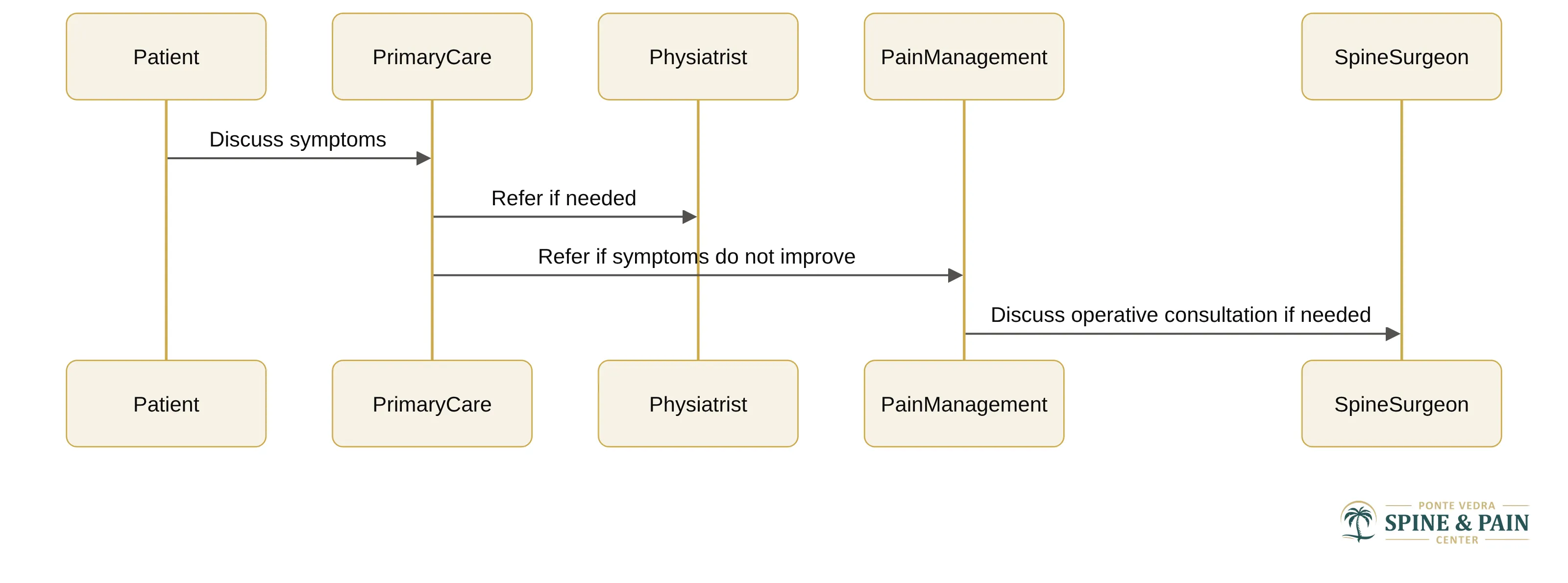
Provider roles for herniated-disc care overlap, but each clinician may contribute at a different point in evaluation or treatment planning. Several types of clinicians may treat herniated discs, including primary care physicians, physiatrists, pain management physicians, and orthopedic spine surgeons. A primary care doctor is also a reasonable place to start and may refer you to another doctor if needed.
The comparison below describes possible roles rather than a required sequence for every person. Your symptoms, examination findings, prior care, and goals determine which conversation is most useful.
Provider roles can be compared by the question you need answered:
| Provider role | What the role may contribute | When the role may fit your search |
|---|---|---|
| Primary care physician | Initial discussion of symptoms and coordination of next steps | You want a broad starting point or need help deciding which specialist to see |
| Pain management physician | Evaluation and discussion of targeted pain management options | You want to discuss interventional options for an identified disc problem |
| Orthopedic spine surgeon | Consultation about whether an operative option belongs in the plan | The evaluation raises a question about an operative consultation |
Your provider choice should follow the question you need answered. If you are uncertain whether your symptoms reflect a disc problem, choose a clinician who can evaluate the broader picture. If a herniated disc has already been identified and you want to discuss targeted pain management, a pain specialist may be a reasonable destination to compare. If the evaluation raises a need for an operative consultation, ask how that referral fits into the plan rather than assuming that every case follows the same path.
Take the next step that matches the unanswered question: seek broader evaluation when the diagnosis is unclear, or seek pain management planning when you want to discuss targeted options for an identified problem.
Use the evaluation process as your first quality test
A herniated-disc evaluation should connect your reported symptoms with a physical examination and, when appropriate, imaging. Spine specialists may use those tools to confirm a herniated disc and identify nerve compression. The point is not simply to attach a label to an image; it is to clarify whether the findings and your symptoms belong in the same treatment discussion.
You can make the first visit more useful by preparing a concise account of:
- When the back or neck symptoms began and how they have changed.
- Whether you have numbness, tingling, weakness, or persistent pain.
- What activities or positions affect your symptoms.
- Any prior imaging, medication, physical therapy, or other treatment.
- What you want to do more comfortably or consistently.
This information gives the clinician a clearer basis for discussing possible next steps. It also lets you judge whether the evaluation addresses your actual concern instead of focusing only on a scan report.
The evaluation itself gives you practical information about provider fit. You should be able to explain what the clinician is assessing, what finding supports the working explanation, and what question the recommended treatment is meant to answer. Ask how the plan would change if your symptoms, examination, or imaging do not point to the same cause.
A useful evaluation does not require a promise about the outcome. It should provide a clear explanation of the clinical question, the available options, and the boundaries of the recommendation. If those points remain unclear, ask for the reasoning in plain language before deciding whether to continue the discussion.
Use these questions to assess the process during or after the visit:
- What is the leading explanation for my symptoms?
- Which examination findings support that explanation?
- What does the imaging show, and how does it relate to my symptoms?
- What problem is the proposed treatment intended to address?
- What alternatives should I understand before choosing?
- What information would change the plan?
Choose a provider who can address those questions without treating an image, procedure name, or symptom label as the entire evaluation.
Judge recommendations against evidence and personal goals
Treatment recommendations for herniated-disc pain should reflect your condition and reported symptoms rather than a universal ranking. A separate narrative review states that treatment choice depends on disease stage and the symptoms you report.
That narrative review also states that an operation may provide faster pain relief, while approaches with and without an operation may aim for similar goals after two years. Those are population-level observations, not a prediction for you. Use them to ask why a recommendation fits your clinical picture, not to decide in advance which category you should select.
Before agreeing to a treatment plan, ask:
- What symptom or functional problem is this recommendation intended to address?
- Which examination or imaging findings make it relevant to me?
- What nonprocedural alternatives should I understand before deciding?
- What would count as a meaningful response for my goals?
- What is the next discussion if the first recommendation does not fit my preferences or situation?
Your goals belong in the conversation. You may care most about tolerating work, sitting through a drive, sleeping, walking, or returning to a specific activity. A recommendation is easier to evaluate when the clinician explains how it relates to the goal you have identified.
A provider-fit decision also includes communication. If an explanation is difficult to follow, ask for the clinical reasoning in plain language. If the recommendation changes because of a new examination finding or imaging result, ask what changed. These questions do not require you to select a treatment during the first conversation; they help you decide whether the care process is aligned with your priorities.
Make the decision criterion explicit: choose the provider who can connect the recommendation to your symptoms, findings, goals, and available alternatives.
Understand where image-guided pain management may fit
An epidural injection may be considered in some herniated-disc treatment plans, but it is not an automatic first step.
Your provider should explain where the option fits and what question it is intended to address.
When an epidural injection is discussed, ask specific questions rather than treating image guidance as a prediction of a particular result:
- What symptoms or findings make the injection relevant?
- What area is the procedure intended to target?
- What other treatment categories remain available?
- How will the clinician decide whether the plan should continue, change, or stop?
Ponte Vedra Spine & Pain Center performs epidural injections under live X-ray guidance with contrast to confirm precise medication placement. That is a description of the procedure method, not a prediction about what the procedure will do for you.
The relevant comparison is whether the clinician can explain the treatment target, the reason for using an injection at that point, and how the option relates to your goals. If you prefer to begin with nonprocedural care, say so. If you are seeking a targeted pain management discussion after a diagnosed disc problem, ask how the evaluation would determine whether image-guided treatment belongs in the plan.
Take action based on the explanation: continue the discussion when the target and rationale are clear, or pause and ask for clarification when they are not.
Review the local practice by treatment scope, not promises
Ponte Vedra Spine & Pain Center offers a local option to compare when you want evaluation and interventional pain management for spine-related symptoms. We bill Cigna for evaluations and interventional procedures, including epidural injections, nerve blocks, radiofrequency ablation, and spinal cord or peripheral nerve stimulation. We perform the listed Cigna procedures under live X-ray or ultrasound guidance.
For epidural injections specifically, we perform the procedure under live X-ray guidance with contrast to confirm precise medication placement. The useful question is whether this treatment scope matches the type of evaluation and discussion you want, not whether a list of procedures predicts a particular outcome.
Ponte Vedra Spine & Pain Center offers compassionate care for people in Ponte Vedra Beach and surrounding areas managing chronic discomfort. That local context may matter if you live in the Jacksonville Beaches, Nocatee, or St. Johns County and want a nearby pain management conversation.
Use the scope of care to prepare focused questions:
- Which part of the evaluation will address your suspected or diagnosed herniated disc?
- Which treatment categories relate to your symptoms and goals?
- How does image guidance fit a procedure under consideration?
- Which options remain available if you prefer to begin without a procedure?
A treatment catalog is a starting point for discussion. It is not a substitute for the evaluation that determines whether a particular option belongs in your plan.
You can compare Ponte Vedra Spine & Pain Center with another local destination using the same criteria: evaluation clarity, relevant treatment scope, image-guided capability, communication, location, and practical scheduling. This keeps the comparison fair. It also prevents the search phrase from turning into an unsupported ranking.
Write down the two or three questions most relevant to your situation before contacting a provider. Then use the answers, rather than the length of a service list, to decide whether the destination fits your needs.
Check practical fit before requesting an appointment
Practical fit matters because herniated-disc care may involve more than one conversation. If you live in Ponte Vedra Beach or a nearby Jacksonville Beaches, Nocatee, or St. Johns County community, consider travel time, appointment availability, and whether the clinic can address the type of evaluation you are seeking.
Prepare the information that will help the scheduling conversation stay focused:
- Your contact details and preferred timing.
- The location of your symptoms and how long they have persisted.
- Whether a clinician has already identified a herniated disc.
- Prior imaging or treatment information you can describe.
- Your insurance information and the main question you want answered.
Use this list before you submit your details so the initial conversation starts with a clear clinical question.
Insurance details can affect practical planning. We verify specific Cigna policies before scheduling visits to confirm benefits and estimate costs. If you have Florida Blue coverage, please bring your Florida Blue card and a photo ID to your appointment.
Coverage and appointment arrangements can vary by policy and circumstance. Include accurate insurance information when you provide your details so the scheduling conversation has the relevant starting point.
A strong practical fit does not mean that you have already selected a treatment. It means you know what you want evaluated, what information you can provide, and which questions you want answered. That preparation lets you compare the local option against your needs without assuming that a particular procedure will be recommended.
Choose the next step when the provider’s location, evaluation scope, communication approach, and practical arrangements match the questions you need answered.
Request an evaluation without committing to a treatment
Choosing a doctor for herniated-disc pain comes down to fit: evaluation quality, provider role, treatment scope, image-guided capability, communication, and practical access. Persistent back or neck pain, numbness, tingling, or weakness should not be ignored, but those symptoms still require a proper evaluation rather than an online conclusion.
A qualified medical professional must determine whether a particular evaluation or treatment is suitable for you after considering your history, examination, and available imaging. If the local option matches the questions you need answered, provide your contact details, preferred timing, clinic selection, insurance information, and notes so the scheduling conversation can begin.
The right next step is a focused conversation about your symptoms, goals, and available treatment categories. You can seek that evaluation without promising yourself a particular procedure in advance. Bring the questions that matter most to you and let the evaluation determine which options deserve further discussion.
Questions to ask before choosing a herniated-disc pain specialist
What should I consider when choosing a doctor for herniated disc pain?
When selecting a doctor, consider how they evaluate your symptoms, the treatment options they offer, their approach to procedures, and whether their practical arrangements align with your needs.
What types of doctors can treat a herniated disc?
Several types of doctors can treat herniated discs, including primary care physicians, physiatrists, pain management physicians, and orthopedic spine surgeons.
How does the evaluation process work for herniated disc treatment?
The evaluation typically involves discussing your symptoms, a physical examination, and possibly imaging to confirm a herniated disc and identify any nerve compression.
What non-surgical treatment options are available for herniated disc pain?
Non-surgical treatment options may include physical therapy, anti-inflammatory medications, and image-guided injections like epidural steroid injections.
How can I prepare for a conversation about my treatment options?
Prepare by outlining your symptoms, any previous treatments, and your goals for treatment, which will help guide the discussion with your provider.
What is the role of image-guided treatments in managing herniated disc pain?
Image-guided treatments, such as epidural injections, may be used to target specific areas for pain relief, but they are not always the first step in treatment.
Living with this?
We treat this in Ponte Vedra Beach.
Dr. Eli Loch, D.O. — double board-certified in anesthesiology and pain medicine. Reading about it only goes so far; a diagnosis tells you which of these actually applies to you.