
cervical lordosis
Cervical Lordosis: What the Curve Means and When to Seek an Evaluation
What does cervical lordosis mean?
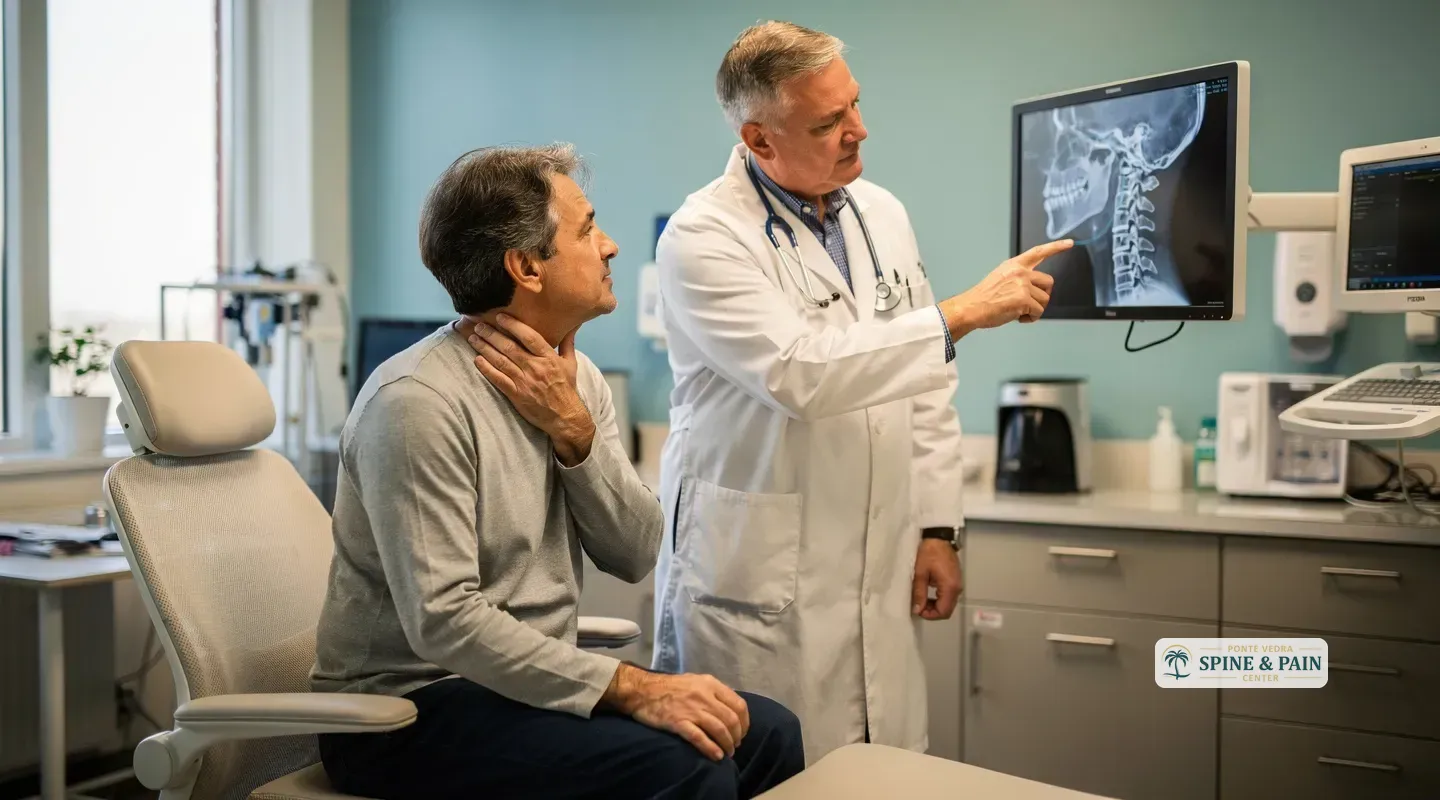
Cervical lordosis describes the inward curve of the neck portion of your spine, usually as it appears on an imaging report. The phrase describes alignment; it does not diagnose a condition or decide which treatment you need.
The curve is not automatically a problem or a treatment goal. Its significance depends partly on how it interacts with other alignment measures and the balance of the spine as a whole. A report that mentions a straightened, reduced, or reversed curve therefore deserves context rather than an immediate conclusion.
The word “cervical” refers to the neck. “Lordosis” refers to an inward spinal curve. Together, the term identifies a shape or direction seen on an image. It does not tell you by itself whether a disc, joint, nerve, muscle, or another structure is causing pain.
An alignment finding can become one topic in a broader neck pain management discussion. At our Ponte Vedra Beach center, an imaging phrase alone does not determine the next step in your care.
Why the curve’s direction is only one part of the picture
The direction of a cervical curve is only one part of how your neck alignment is understood. A more pronounced inward curve, a less pronounced curve, or a curve that appears reversed may matter differently depending on symptoms, examination findings, other cervical measurements, and the relationship between the neck and the rest of the spine.
A curve is not automatically abnormal simply because its appearance differs from a textbook image. The alignment review explains that lordosis is not universally physiological and should not be pursued as a treatment goal for every person undergoing cervical spine surgery. The review instead emphasizes the interaction between angular measures, translational measures, and overall spinal balance.
That distinction matters if an imaging report uses a strong-sounding term. The wording may describe what the neck looks like in one position on one study, while your symptoms may involve movement, nerve irritation, muscle tension, a joint, or another structure. The report is a starting point for questions, not a complete explanation.
A cervical alignment report becomes more useful when you connect it with practical questions:
- What symptoms are present, and where do they travel?
- Has neck movement become limited or painful?
- What did the physical and neurological examination show?
- Does the image show other findings that fit the symptoms?
- Is the reported curve part of a broader alignment pattern?
If you’re considering neck pain management near Ponte Vedra Beach, those questions create a more useful starting point than treating the curve label as a diagnosis. A clinician can decide which parts of the report deserve attention and which do not.

What increased, reduced, or reversed curves may indicate
An increased cervical curve means the inward shape appears more pronounced, while a reduced or straightened curve means the inward shape appears less pronounced. A reversed curve describes an alignment pattern that moves in the opposite direction on the image. None of these descriptions, by themselves, establishes why the curve looks that way or whether it explains your symptoms.
More severe lordotic curves can cause neck or low back pain and make normal movement difficult. A systematic review of reversed cervical lordosis, published in 2025, included fifteen studies encompassing 645 patients. Common findings in those studies included persistent neck pain, limited cervical mobility, and radicular symptoms in some cases. Those findings describe patterns seen across the reviewed studies; they do not show that a reversed curve is the cause of every person’s pain.
A cervical curve can also reflect a larger alignment pattern rather than an isolated neck problem. The review of cervical alignment explains that angular parameters such as lordosis or kyphosis interact with translational parameters and balance across the spine. That is why a clinician may discuss the curve’s direction while also considering your symptoms, movement, examination, and the rest of the imaging report.
If a report uses the words increased, reduced, or reversed, write down the exact wording and bring the report to an evaluation. The useful question is not simply whether the curve is present. It is whether the finding fits the clinical picture and changes what should happen next.
The 2025 review also notes how the reversed pattern was identified: primarily by a negative Cobb angle on lateral cervical radiographs. A Cobb angle is a measurement taken from the image. It describes the radiographic relationship, not the intensity of pain or the source of symptoms. This helps explain why the report still needs to be compared with examination findings and daily function.
How symptoms can change the significance of an imaging finding
Symptoms still do not prove that the curve caused them. A similar imaging description may appear in people with different symptoms, and similar symptoms may come from different structures. The timing matters too: note whether the discomfort began after an injury, developed gradually, or changes with neck movement or position.
The location and behavior of pain can help organize the discussion. Pain that stays near the neck raises different questions from pain that travels into the shoulder, arm, or hand. Limited movement, altered sensation, or weakness adds further context, but none of these features identifies a cause without an examination.
Cervical radiculopathy involves chronic pain caused by irritation and inflammation of spinal nerve roots in the neck. The pain can radiate from the neck toward the shoulders, arms, or hands. Radiating pain does not identify the cause by itself, but its path and pattern give a clinician information to combine with the examination and imaging.
Before a neck pain management visit in Ponte Vedra Beach, you can prepare a short symptom record:
- Where the pain begins and where it travels
- Whether numbness, tingling, or weakness accompanies it
- Which movements change it
- How long the symptoms have lasted
- Whether the symptoms limit work, sleep, driving, or other ordinary activities
This record helps keep the discussion focused on function and symptoms rather than on the imaging phrase alone.

What alignment research can—and cannot—show
Alignment research can show associations across groups, but it cannot turn your imaging report into an individualized diagnosis. One review describes C2-C7 SVA as a translational marker of cervical sagittal balance and explains that broader balance may matter alongside the curve’s angle.
Among patients undergoing cervical spine surgery, higher C2-C7 SVA values were associated with higher reported Neck Disability Index scores, while higher cervical lordosis and T1-slope values were associated with lower scores. These were associations in a surgical population. They do not establish that changing one measurement will produce a particular result for you.
The distinction between association and causation is practical. A measurement can appear alongside disability without being the only reason for that disability. It can also be related to other alignment features that are not obvious from a short phrase in a report. Ask which measurement is being discussed, what it measures, and how it relates to your symptoms.
This creates two different questions: what does the angular value say about the curve, and what does a translational measure such as C2-C7 SVA say about sagittal balance? Asking both questions can prevent a single number from becoming a stand-alone diagnosis. The answer still depends on your history and examination.
A multi-centre North American trial of 56 patients with cervical spondylotic myelopathy undergoing surgery found that pre-operative C2-C7 SVA, but not C2-C7 lordosis or kyphosis, was associated with modified Japanese Orthopaedic Association scores. The finding illustrates why a clinician may assess more than the cervical curve itself.
The practical boundary is clear: an alignment measurement can add context, but it cannot replace your history, examination, or clinical judgment. Our neck pain management discussions use imaging as one part of the conversation rather than standing alone as a treatment decision.
What a clinician may review before suggesting next steps
A clinician may review your symptom history, movement limits, neurological findings, and imaging context before suggesting next steps. The purpose is to connect the report with your actual condition rather than treat one radiology phrase as the conclusion.
That review may include the location and duration of pain, symptoms in the shoulder or arm, changes in strength or sensation, and any effect on balance or walking. It may also include questions about systemic symptoms. During a neck-pain evaluation, clinicians may ask about unexplained weight loss, night sweats, and persistent fever because those symptoms can signal a serious systemic condition.
Your prior care also gives the discussion useful context. Tell the clinician about earlier imaging, injections, therapy, injuries, and medicines, along with what changed afterward. A timeline can help separate a long-standing imaging finding from a newer symptom or functional change.
The appropriate imaging study depends on the clinical scenario. In the selected American College of Radiology appropriateness table, cervical-spine MRI without and with IV contrast is rated Usually Appropriate for the listed scenario. MRI without IV contrast and CT with or without IV contrast are rated May Be Appropriate for that scenario. Cervical spine radiography, including flexion-extension lateral views, is rated Usually Not Appropriate for the listed scenario.
Those ratings are not a personal imaging order. They show why the wording of the clinical question matters. Bring the complete report, the images if available, and a list of prior evaluations to your appointment so the clinician can consider the findings in context.
They also show why the same imaging category should not be treated as a universal sequence for every neck complaint. Before deciding whether existing imaging answers the relevant question, a clinician may need to clarify the symptom pattern and examination findings that define the scenario. That step keeps the table’s general guidance separate from an individualized imaging decision.

When neck symptoms call for a professional evaluation
Persistent neck pain, restricted movement, pain extending toward an arm or hand, or symptoms that interfere with normal activities are reasonable reasons to arrange a professional evaluation.
The image does not need to look dramatic for your symptoms to deserve attention, and an unusual curve does not require treatment simply because it appears on a report. The decision depends on the complete clinical picture. Write down what has changed, how long it has lasted, and which activities have become harder.
A visit can also be reasonable when you are unsure how to interpret the report, especially if the wording is new or follows an injury. Bring the report and describe what you feel in plain terms. You do not need to decide in advance whether the curve is the cause.
Neck-pain evaluations may screen for unexplained weight loss, night sweats, and persistent fever, which can signal a serious systemic condition. Neurological warning signs discussed in these evaluations include gait changes, loss of balance, or sudden bowel and bladder dysfunction.
These warning signs are not a way to diagnose yourself from an article. They are examples of information that can change the questions a clinician asks during an evaluation. Persistent pain or loss of function also needs context: timing, symptom pattern, examination, and imaging should be considered together rather than assigning meaning to one symptom or one curve description.
What broad treatment approaches may be discussed
Treatment discussions for cervical alignment concerns may include conservative care, targeted procedures, or other options selected for the symptoms and suspected pain generator. That finding does not make either approach appropriate for every person, and it does not promise a particular result.
A clinician may also discuss what should be monitored, what activity or movement limits matter, and whether additional assessment is needed. The purpose of these options is not automatically to restore a particular curve. The purpose is to address the clinical problem identified through the evaluation.
Cervical epidural steroid injections are intended to help manage chronic pain caused by irritation and inflammation of cervical spinal nerve roots due to certain conditions or injuries. This description concerns a specific pain pattern; it does not mean that an epidural injection treats cervical lordosis itself.
We provide epidural injections, facet and medial branch blocks, joint injections, and nerve blocks under live X-ray or ultrasound. These are available services, not a recommendation for your individual situation. The relevant question is whether an option matches your symptoms, examination findings, imaging, and clinical goals.
Why treatment should follow the pain generator, not the image alone
Treatment should follow the suspected pain generator and the broader clinical picture rather than the image alone. The curve is not automatically a treatment goal, and its significance depends partly on its relationship with other alignment measures and overall spinal balance.
A 2025 systematic review also reported significant improvements in cervical alignment and clinical outcomes after anterior cervical discectomy and fusion or posterior fusion, particularly among patients with severe or refractory symptoms. That finding describes a selected surgical context; it does not make surgery a default response to an imaging phrase or establish that it is appropriate for you.
Those findings describe different treatment contexts and do not establish that surgery, traction, or any other option is right for you.
A treatment discussion should connect the proposed option to a defined clinical problem. Ask what symptom or finding the option is intended to address, what other approaches have been considered, and what would prompt a change in the plan. Those questions keep the focus on your condition rather than on correcting an image in isolation.
A useful appointment question is: “What finding appears to be generating my symptoms, and how does the cervical curve affect that assessment?” You can also ask which findings are actionable, which are incidental, and what supports the proposed next step.
The presence of those services does not make the image itself an indication for treatment.
How a Ponte Vedra pain-management evaluation can organize the discussion
Dr. Eli Loch is double board-certified in anesthesiology and pain medicine by the American Board of Anesthesiology. You can make an appointment discussion more efficient by bringing:
- The cervical imaging report and, if available, the images
- A list of symptoms, their duration, and their effect on daily function
- A medication and prior-treatment list
- Details about any injury, prior injection, or other spine evaluation
- Questions about which finding appears to match your symptoms
A clear record helps keep the conversation specific. It also gives you a practical way to compare the report with what you feel in your neck, shoulder, arm, or hand.
Discuss your cervical lordosis concerns with a local pain specialist
This imaging description is not a diagnosis by itself. Use the report as a starting point, then bring your symptoms, functional limits, neurological changes, and any warning signs to a qualified healthcare professional who can decide what they mean together.
If you live in Ponte Vedra Beach or nearby St. Johns County, we offer image-guided injections, radiofrequency ablation, nerve stimulation, and regenerative therapy. A clinical discussion can help you understand which questions to raise about your neck pain and the findings on your imaging.
What should you bring to a cervical lordosis evaluation?
Is cervical lordosis serious?
Not necessarily. Cervical lordosis describes the shape of the neck’s curve, not a diagnosis or a measure of severity by itself. Its significance depends on your symptoms, examination, other imaging findings, and overall spinal alignment. Persistent pain, limited movement, radiating arm symptoms, or neurological changes make an evaluation more useful.
Can cervical lordosis be corrected in adults?
The appropriate goal isn’t automatically to restore a particular curve. Treatment depends on the suspected pain generator, symptoms, examination findings, and broader alignment. An individualized evaluation is needed before discussing correction.
What should I bring to an evaluation for cervical lordosis?
Bring the complete imaging report and, if available, the images, along with a symptom timeline and list of prior treatments or injections. Note where pain travels, whether you have numbness or weakness, what movements change it, and how symptoms affect daily activities. At Ponte Vedra Spine & Pain Center, these details help frame a discussion about whether available options, such as image-guided injections, fit the clinical picture.
What symptoms may be relevant during a neck-pain evaluation?
During a neck-pain evaluation, clinicians may ask about unexplained weight loss, night sweats, and persistent fever because these symptoms can signal a serious systemic condition. Neurological warning signs discussed in neck-pain evaluations include gait changes, loss of balance, or sudden bowel and bladder dysfunction.
Living with this?
We treat this in Ponte Vedra Beach.
Dr. Eli Loch, D.O. — double board-certified in anesthesiology and pain medicine. Reading about it only goes so far; a diagnosis tells you which of these actually applies to you.