
Back & spine pain treatment
Back & Spine Pain Treatment: A Decision Guide by Pain Pattern and Suspected Source

Start with the pain pattern, not a procedure
The location of your pain, its direction, the activities that change it, and the symptoms that accompany it can help frame the evaluation. A clinician then considers the suspected pain source, your prior care, and your functional limits before deciding which options are reasonable to discuss.
Facet-mediated lumbar pain, lumbar spinal stenosis, herniated-disc pain, and nerve-related symptoms can overlap. Similar words such as back pain or sciatica do not identify one confirmed source. The practical goal is to connect your pattern to a focused clinical question.
A useful treatment discussion follows four linked steps:
- Describe the pattern: Explain where symptoms begin, where they travel, and what standing, walking, sitting, bending, or other activities change them.
- Clarify the suspected source: Use history and examination to distinguish a possible facet, disc, nerve-root, or stenosis-related pathway from other explanations.
- Review prior care: Include exercise, physical therapy, education, manual therapy, injections, and other approaches you have already tried.
- Choose the next discussion: Consider active conservative care, image-guided treatments, diagnostic blocks, radiofrequency procedures, or selected neuromodulation only within the pathway that fits the evaluation.
Clinical guidance generally places education, manual therapy, and supervised exercise within care for persistent low back pain. Facet-pain guidance also emphasizes patient-centered care, psychosocial screening, education, exercise, and physical therapy. These categories inform a conversation; they do not determine your individual plan.
Johns County. You do not need to decide on a treatment before seeking an evaluation. You need enough information to describe the problem clearly and ask which pathway deserves attention first.
A local appointment can be useful even when you are uncertain whether your symptoms come from a disc, facet joint, narrowed spinal canal, or nerve-related source. The purpose is to make the next decision more specific, not to arrive with a procedure already chosen.
Recognize patterns that change the treatment discussion
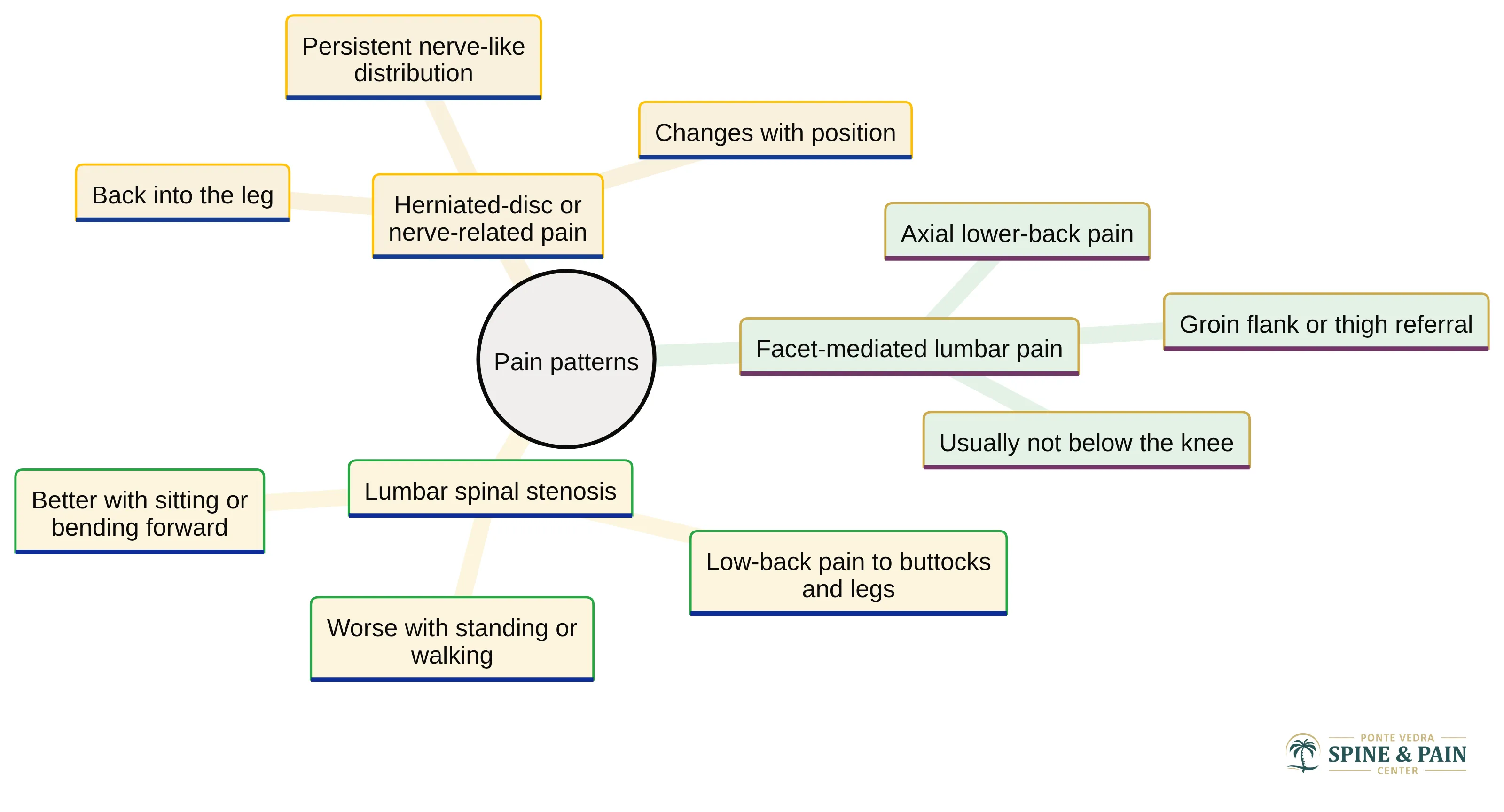
Facet-mediated lumbar pain is generally axial, meaning it stays primarily in the lower back rather than following a long path down the leg. The pain may refer toward the groin, flank, or thigh and usually does not extend below the knee. That pattern can make a facet source part of the discussion, but it does not establish the diagnosis by itself.
Facet-related symptoms can resemble pain from a herniated disc or a compressed nerve root. Your description therefore helps organize the evaluation, but history alone may not identify the source reliably.
Lumbar spinal stenosis is a degenerative narrowing around spinal neurovascular structures that can produce low-back pain radiating toward the buttocks and legs. Stenosis-related symptoms typically worsen with standing or walking and improve with sitting or bending forward. The relationship between symptoms and posture matters because it gives the clinician a functional pattern to examine.
If walking distance has changed, describe how far you can walk before symptoms begin, whether sitting changes them, and whether bending forward affects your tolerance. Those details are more useful than labeling every leg symptom as sciatica.
A practical example is a change in how you move through a grocery store, neighborhood, or parking lot. Note whether you need to stop, sit, lean forward, or shorten the trip. That information connects the symptom to function.
That functional pattern helps compare options without assuming that one label determines the answer. The selected review lists physical therapy, exercise programs, spinal injections with or without corticosteroids, manual approaches, acupuncture, and lifestyle modification among options for lumbar spinal stenosis. It also notes that few of these options have high-quality randomized trials demonstrating effectiveness. That limitation belongs in the comparison: an option can be reasonable to discuss while its evidence and intended outcome remain specific to the condition and patient. Ask which option is meant to improve walking tolerance, manage symptoms, or support function, and how that goal will be assessed.
Herniated-disc and nerve-related pain deserve a separate discussion when symptoms extend from the back into the leg or follow a persistent nerve-like distribution. A herniated disc matters to treatment decisions when its suspected location and your symptoms fit together; the scan or label alone does not answer that question.
The appropriate role of an injection depends on the clinical evaluation, so bring the distribution, duration, triggers, and functional effect of your symptoms to the discussion.
Record whether symptoms remain in one area or travel along the leg, whether they change with position, and whether they affect walking, sitting, sleep, or work. That description gives the clinician a clearer starting point than the phrase “disc problem” alone.
Why similar symptoms require different evaluation
Back and leg symptoms can arise from different structures, which is why similar pain descriptions may lead to different evaluations. Facet-mediated pain is commonly axial and referred, while stenosis can produce symptoms that increase with standing or walking and ease with sitting or flexion. Disc-related or nerve-root symptoms may overlap with either pattern.
A treatment category should follow the suspected source rather than replace source identification. For you, that means describing the complete pattern instead of asking only which injection or device is available.
A clinical assessment considers more than the most noticeable symptom. Expect the discussion to address:
- Where the pain begins and where it travels.
- Whether symptoms are mainly axial, referred, or leg-dominant.
- Which positions and activities increase or reduce symptoms.
- Whether weakness, sensory changes, or other concerning features accompany the pain.
- What care you have already tried and how your function changed afterward.
- Whether the overall pattern supports imaging or another focused evaluation.
Initial evaluation should screen for concerning features. Selected guidelines endorse a trial of management without imaging for adults who do not have the relevant clinical factors identified by those guidelines. Imaging decisions therefore belong within the clinical context, not beside it.
Treatment selection also considers what you want to regain. Tell the clinician whether your main limitation is walking, sitting, sleep, work, exercise, or another activity. Your goals help distinguish a plan aimed at symptom management from a plan that also tracks functional change.
Prior care matters as well. Facet-pain guidelines recommend reviewing conservative treatment before considering facet interventions, while spinal cord stimulation guidance emphasizes understanding the indication, expected effects, and ongoing care. The sequence is individualized rather than automatic.
Bring both successful and unsuccessful attempts into the discussion. A treatment that did not change your walking tolerance may still have affected another symptom, while an approach that helped briefly may offer information about the next question to ask.
Use examination and selective imaging to clarify the pathway
A physical examination connects your symptom description with observable function and clinical findings. The clinician may use your movement pattern, neurologic findings, and pain distribution to decide which source deserves closer attention. Those findings can also identify alternative explanations that would change the next step.
Facet-mediated pain can resemble disc or nerve-root pain, so a familiar pain pattern does not prove a facet source. A focused examination helps keep the treatment discussion tied to the whole clinical picture.
Imaging is most useful when it answers a clinical question. The selected review identifies magnetic resonance imaging as the recommended diagnostic test for lumbar spinal stenosis because it measures the spinal canal in cross-section. That recommendation applies to the evaluation of suspected lumbar stenosis; it does not mean every episode of low back pain requires an MRI.
For you, the relevant question is not whether an image exists but whether the findings match your symptoms and examination. Ask what the clinician is looking for, how the result would change the pathway, and whether the scan explains your functional pattern.
That distinction gives selective imaging a decision role rather than making it a completeness test. For adults without the relevant clinical factors identified by those guidelines, the selected review describes a trial of management without imaging. When lumbar spinal stenosis is the clinical question, the selected review identifies MRI as a way to measure the spinal canal in cross-section. In either case, the value of imaging comes from how the result changes the next discussion. Ask what finding would support the proposed pathway, what finding would redirect it, and what symptoms would remain unexplained. This makes the imaging decision transparent without treating the scan as the treatment plan.
Selective imaging can separate structural information from clinical interpretation. A scan may show narrowing, disc changes, or other findings, but treatment discussion still depends on whether those findings correspond with your symptoms. The stenosis review lists MRI as a way to measure the spinal canal; the initial-evaluation review supports clinical screening before imaging decisions.
Bring prior reports and images when they are available, but do not assume that an imaging label settles the treatment question. Ask which finding is clinically relevant and which option would address the suspected source.
If an image and your symptoms seem inconsistent, raise that difference directly. The question is not whether the scan is abnormal in isolation; it is whether the finding helps explain the pattern that limits you.
Begin with active conservative care when appropriate
Active conservative care gives you a structured starting point when the evaluation supports it. Clinical guidelines generally recommend education, manual therapy, and supervised exercise for persistent low back pain. Facet-pain guidance also includes patient-centered care, psychosocial screening, back-pain education, exercise, and physical therapy.
These recommendations are not a command to repeat an approach that has already failed. They create a framework for discussing what you tried, how consistently you could use it, what changed, and what remains limited.
The phrase “conservative care” can cover several different experiences. Ask which part of the plan is intended to affect mobility, strength, activity tolerance, symptom management, or understanding of your condition.
Exercise is an important strategy for managing acute and chronic back pain, and the selected review identifies resistance training as the most efficient exercise strategy. The same review emphasizes objective measurement when prescribing intensity, duration, and repetition rather than relying only on subjective impressions.
Your exercise discussion should therefore include the dose you can perform, the movements that aggravate symptoms, and a way to track function. A program should be adapted to your clinical findings and current capacity rather than copied from a general list.
Useful measures might include walking duration, time seated, lifting tolerance, sleep interruption, or the task you most want to resume. Choose measures that relate to your daily life and discuss how they should be recorded.
That baseline has a practical purpose. It lets the clinician compare the planned exercise dose with what you could actually perform and distinguish a change in symptoms from a change in function. If walking duration improves while pain remains, that is different information from pain changing without greater activity tolerance. If a prescribed movement cannot be completed, discuss whether its dose or fit should be adjusted rather than treating that experience as proof that exercise is unsuitable. Direct performance measures can make the clinical picture clearer than relying on general impressions alone.
A practical review of conservative care can use four questions:
- What was the intended target: general function, walking tolerance, strength, mobility, or symptom management?
- What could you complete consistently, and what prevented completion?
- Which measurable activity changed, if any?
- What remains unresolved after a reasonable trial?
Treatment timing and duration are highly individualized. Before facet interventions are considered, clinicians should review whether conservative treatment was received. That review supports a more precise next step; it does not impose one universal timetable.
If symptoms changed during care, describe the change rather than labeling the entire approach a success or failure. The distinction can help determine whether the next discussion should focus on adjustment, continuation, another evaluation, or a different treatment category.
Match image-guided injections to the suspected source
Before discussing an epidural injection, ask how the suspected source was identified and what the injection is intended to clarify or manage. A useful conversation covers:
- Whether your symptoms and examination fit a disc-related or stenosis-related pathway.
- Whether imaging is relevant to that question.
- What prior conservative care has shown.
- What functional change would be tracked afterward.
- What the next discussion would be if the intended change does not occur.
The selected stenosis guidance describes symptomatic benefits over a short to intermediate period; it does not establish a lasting result for every person. Keep that limitation beside the treatment discussion.
That limitation also sets a boundary on comparison. The selected guidance concerns symptomatic lumbar spinal stenosis; it should not be treated as a general result for every epidural injection, every cause of back pain, or every duration of benefit. Ask whether the proposed target is stenosis-related symptoms and whether the expected endpoint is symptom change, walking tolerance, or another function. If corticosteroids are part of the discussion, ask how the clinician is applying the guidance that found no added benefit over local anesthetic in that stenosis context. This keeps a condition-specific finding from becoming a blanket assumption.
An injection should not be chosen simply because a scan mentions a disc or narrowing. The relevant question is whether the suspected source, your symptoms, examination, prior care, and treatment goal align. If those pieces do not align, ask what evaluation would clarify the pathway before discussing an injection.
That approach keeps image-guided treatments within a broader pain-management plan rather than treating them as isolated answers. It also gives you a clear way to judge the discussion: the clinician should be able to explain the target, the reason for the option, and the function that will be followed.
Separate diagnostic blocks from radiofrequency procedure decisions
Diagnostic blocks and radiofrequency procedure decisions belong to a facet-focused pathway, not to a general back-pain checklist. Facet-pain guidelines emphasize patient-centered care, education, exercise, physical therapy, and review of prior conservative treatment before facet interventions are considered.
A block discussion asks whether the suspected facet pathway is sufficiently plausible to test or evaluate. A later radiofrequency discussion asks whether the clinical information, prior care, and ongoing functional limitation support considering that procedure. The two decisions should not be treated as interchangeable.
Facet-mediated lumbar pain is generally axial and may refer to the groin, flank, or thigh, but it can resemble disc or nerve-root pain. That overlap is why pain location alone cannot establish a facet source.
Your clinician may therefore review the full pattern before discussing a block or radiofrequency procedure. Describe whether pain extends below the knee, which movements reproduce it, how your function is limited, and which conservative approaches you have completed. Those details help separate a facet-centered discussion from another pathway.
A proposed procedure should have a stated purpose. Ask whether the purpose is to gather diagnostic information, manage symptoms, or address a particular functional limitation.
The timing of facet interventions is individualized, and clinicians should confirm prior conservative care before considering them. No fixed interval applies to every person. Ask what finding supports the proposed step, what outcome would be measured, and what other source would be reconsidered if the pattern does not fit.
A clear boundary is useful: do not treat a diagnostic block or radiofrequency procedure as a default response to lower back pain. Proceed to that discussion only when the evaluation supports a facet-related question.
Reserve neuromodulation for selected persistent pain
Before spinal cord stimulation, you should receive information about the evidence for the specific indication, procedure-related complications and outcomes, ongoing care, and the possibility of further surgery. You also need adequate time to consider the treatment before consent.
Consensus guidance reports that psychosocial factors may influence long-term outcomes and satisfaction, while also noting that no consensus exists on the best screening method, domains, or tool. That uncertainty supports a careful discussion rather than a checklist-based decision.
The relevant comparison is not simply whether symptoms have lasted a long time. The discussion should connect the pain pattern, the indication, previous care, functional effect, expected role of treatment, and continuing care.
A clinician still must determine whether your symptoms, prior care, indication, and goals fit that discussion.
Ask about the expected effects for your specific indication, the continuing care involved, how function would be tracked, and which alternatives remain relevant. A device conversation should include the full care pathway, not only the procedure itself.
A reasonable neuromodulation discussion should connect four elements:
- The persistent pain pattern and its effect on your function.
- The indication-specific evidence and expected effects.
- Your understanding of ongoing care and procedure-related outcomes.
- The screening and discussion needed to support an informed decision.
If the clinician cannot explain how those elements relate to your case, ask for clarification before deciding whether this pathway deserves further consideration. You should also understand what follow-up involves and how the plan would be adjusted if your functional goals changed.
Treat laser and regenerative options as diagnosis-dependent discussions
A discussion of regenerative therapy should also begin with the condition being evaluated rather than the name of the modality. Ask what problem the proposed option is intended to address, what clinical information supports discussing it, how prior care affects the decision, and what outcome would be measured.
A treatment label alone cannot establish suitability. Keep the discussion tied to the suspected source, your symptoms, your functional goals, and the clinician’s evaluation.
Laser or regenerative options should not displace the evaluation that makes their role understandable. Selective imaging, examination, symptom pattern, and prior care still shape the pathway. If the diagnosis remains uncertain, ask what needs to be clarified before comparing modalities.
That approach prevents a common category error: treating a named option as a diagnosis. The useful question is not whether a modality sounds appropriate in general, but whether it has a defined role in your evaluated condition. A clinician should explain the intended target and the way progress would be assessed.
Know when persistent or concerning pain merits assessment
Persistent back or spine pain merits professional assessment when it continues to limit your function, returns despite self-management, or leaves the suspected source unclear. An evaluation can organize the pattern, review prior care, and determine whether examination or selective imaging should guide the next discussion.
Do not wait for a procedure decision before seeking that evaluation. The purpose of the visit is to clarify what the symptoms may represent and which options, if any, fit the pathway.
Bring a short timeline, a description of the activities you cannot perform, and a list of treatments you have tried. Those details can make the first discussion more focused.
Initial evaluation should screen for warning signs, and a review found that a history of malignancy and high clinical suspicion were the only two of seven assessed warning signs with acceptable diagnostic accuracy for malignancy; the evidence was moderate quality.
Tell a clinician about a personal history of malignancy or any feature that feels materially different from your usual pattern. A qualified clinician can determine what assessment is appropriate rather than relying on a general treatment guide.
Because the evidence was moderate and the review assessed specific features, its finding should be read as a reason for contextual assessment, not as a self-screening formula. A warning feature does not by itself identify the cause of pain, and the absence of one does not explain persistent symptoms. Describe what is new, progressive, or unlike your usual pattern, together with the timeline and functional effect. This gives a clinician a better basis for deciding what assessment is appropriate than a checklist used in isolation.
Prepare for a more useful treatment discussion
A focused appointment begins with a focused account of the problem. Before you speak with a clinician, write down:
- Pain distribution: Where symptoms start, where they travel, and whether they remain in the back or extend into the leg.
- Activity pattern: What standing, walking, sitting, bending, driving, sleeping, or exercise changes.
- Functional effect: The distance you can walk, the tasks you avoid, or the activities you can no longer complete as before.
- Timeline: When the current pattern began and whether it has changed.
- Previous care: Exercise, physical therapy, education, manual therapy, injections, imaging, and any other treatment you tried.
- Response: What changed, for how long, and which limitation remained.
- Records: Relevant imaging reports, images, medication information, and prior clinician recommendations.
- Questions: What source is being considered, why a treatment is being discussed, and what would be measured afterward.
This checklist is a preparation tool. It gives you subjects to discuss and does not diagnose the source or determine eligibility.
Use the appointment to test the logic of the proposed pathway. Ask:
- What pain pattern is most relevant to the working assessment?
- Which findings support that suspected source, and which alternatives remain possible?
- Is imaging needed to answer a specific question?
- How does my prior conservative care affect the next step?
- What is the intended role of an injection, block, radiofrequency procedure, laser therapy, regenerative therapy, or spinal cord stimulation?
- What functional change should be tracked?
- What ongoing care or follow-up would the option require?
- If the proposed step is not appropriate, what should be clarified next?
For spinal cord stimulation, include indication-specific evidence, procedure-related outcomes, ongoing care, and the full decision timeline. For facet interventions, include prior conservative care and the reason the facet pathway is being considered.
A simple symptom and function record can make the conversation more concrete. Use it to note the activity, the symptom pattern, the duration, and the change after an intervention or exercise session. For example:
- Activity: Walking, sitting, driving, sleeping, lifting, or exercise.
- Pattern: Back-dominant, referred, or leg-dominant symptoms.
- Change: Better, worse, unchanged, or different in a specific way.
- Function: What you could complete and what you could not.
The record is not a diagnostic test. It is a way to organize your experience and give the clinician a clearer account of what matters in daily life.
To improve the record’s usefulness, note the dose and duration of an activity or treatment when you can: how long you walked, how long you sat, how often an exercise was performed, and how long any change lasted. This does not create a standardized test or replace examination. It adds a time-and-function dimension to the account, which can help the clinician compare prior care with the goal you identified. If the record is incomplete, bring what you know rather than delaying an appointment; uncertainty in the history is itself something to discuss.
Choose a local evaluation without assuming treatment suitability
A local evaluation can help you move from a broad pain label to a more specific discussion of pattern, suspected source, prior care, and function. Those services do not establish that any particular option suits you.
If you live in Ponte Vedra Beach, the Jacksonville Beaches, Nocatee, or St. Johns County and persistent back or spine pain is limiting your life, request an evaluation with your symptoms, treatment history, imaging information, and questions prepared. A qualified clinician must determine individual suitability, and your next step should follow that evaluation rather than a general promise about results.
The most useful decision is the one that keeps the pain pattern, suspected source, examination, prior care, and functional goal connected. That framework gives you a clearer basis for discussing conservative care, image-guided treatments, facet procedures, neuromodulation, laser therapy, or regenerative therapy.
What should I bring to a back or spine pain evaluation?
What are the common causes of back and spine pain?
Common causes include facet-mediated pain, lumbar spinal stenosis, herniated discs, and nerve-related symptoms. Each type has distinct characteristics that can influence treatment options.
When should I seek professional assessment for persistent back pain?
You should seek assessment if your pain limits your function, returns despite self-management, or if the source of your pain is unclear. An evaluation can help clarify your symptoms and guide treatment.
What role does exercise play in managing back pain?
Exercise, particularly resistance training, is an important strategy for managing both acute and chronic back pain. It should be tailored to your specific symptoms and functional capacity.
How do I prepare for a consultation about my back pain?
Before your consultation, prepare a detailed account of your pain distribution, activity patterns, functional effects, previous treatments, and any relevant imaging reports. This information will help guide the discussion.
What is the significance of imaging in back pain evaluation?
Imaging, such as MRI, is useful when it answers a specific clinical question. It should not be the sole basis for treatment decisions; the findings must correlate with your symptoms and clinical evaluation.
What are the treatment options for lumbar spinal stenosis?
Nonsurgical options for lumbar spinal stenosis include physical therapy, exercise, spinal injections, chiropractic treatment, and lifestyle modifications. However, the effectiveness of these treatments can vary.
Living with this?
We treat this in Ponte Vedra Beach.
Dr. Eli Loch, D.O. — double board-certified in anesthesiology and pain medicine. Reading about it only goes so far; a diagnosis tells you which of these actually applies to you.