
one movement for possible short-term sciatica relief
One Movement for Possible Short-Term Sciatica Relief

Try one gentle movement without expecting a diagnosis
A single gentle movement may or may not ease sciatica symptoms briefly, but it cannot identify why your pain travels. Sciatica is pain caused by irritation or compression of the sciatic nerve, and symptoms may reach the lower back, buttocks, or leg. Moving more and sitting less usually help with sciatica pain. Any improvement is only a change in symptoms during or after activity. It is not proof that the underlying problem has resolved.
The movement in this guide is deliberately modest: take a short, easy walk while your symptoms remain unchanged or ease. Do not force a stretch, lengthen your stride to chase relief, or continue because the title promises an immediate result. Sciatica and sacroiliac joint pain can overlap in location while having different causes and treatment approaches. Your response to walking cannot separate those conditions. Use the movement as a brief symptom check, then stop when your symptoms worsen or travel farther down the leg.
This approach is for a brief, controlled trial of ordinary movement, not for severe or rapidly changing symptoms. You do not need to force yourself through a set distance or judge the movement by whether it produces dramatic relief. The useful question is narrower: do a few comfortable steps leave your symptoms stable or somewhat easier? If not, end the trial and use the change in symptoms as a reason to consider further evaluation.
Why one movement cannot fit every sciatica pattern
Sciatica does not represent one uniform cause, even when the pain follows a familiar path. Sciatica commonly involves irritation or compression in the lumbar spine, while sacroiliac joint pain involves a different structure; the symptoms can overlap. A movement that feels comfortable for one pattern may aggravate another pattern. Stretching can worsen symptoms when it places the nerve under tension or moves in a direction that aggravates the underlying condition. Forward bending may aggravate disc-related sciatica, while backward bending may worsen stenosis.
That variation changes how you should interpret a movement. Comfort during a few steps does not reveal whether a disc, narrowing, sacroiliac structure, or another source is involved. Discomfort during a particular direction does not establish a diagnosis either. The practical aim is narrower: find out whether gentle walking leaves your symptoms stable or somewhat easier without forcing your spine or leg. A worsening response is a boundary, not a challenge to push through.
Sciatica symptoms usually affect the buttocks and the back of one leg, often including the foot and toes. A symptom pattern that differs from that description, changes quickly, or includes neurological warning signs deserves more attention than a home movement test. Keep the distinction clear: a brief walk can show how your symptoms respond to that activity, but it cannot tell you which condition caused them.
Use the movement as a response-based decision, not as a test with a correct score. A stable response allows you to finish the short trial. A worsening response tells you to stop. Neither response identifies the source of your symptoms or tells you which treatment would be suitable.
The single gentle movement to try
The single movement is easy walking at a relaxed pace. Choose a level route with enough room to turn without twisting, and keep the walk short enough that you can pay attention to your symptoms. Walking is different from an aggressive hamstring stretch or a deep forward fold because the goal is ordinary, comfortable movement rather than pulling on the back of the leg. The movement should stay within a range that feels controlled.
Easy walking is intended to test whether light movement feels better than prolonged sitting, not to treat the source of nerve irritation. Moving more and sitting less usually help with sciatica pain, but that general guidance does not establish a particular duration, pace, or amount for you. Begin with a few comfortable steps. Continue only while your symptoms remain stable or ease.
Temporary easing may be useful for getting through the next part of your day, but temporary easing does not confirm that your condition is minor. Sciatica and sacroiliac joint pain may feel similar while requiring different treatment approaches. Treat the walk as a limited self-care experiment, not as a diagnostic maneuver or a substitute for evaluation.
A hallway, quiet sidewalk, or another familiar level surface can work if you can move without rushing. Hold onto a stable support only if you already use one safely; do not add a balancing challenge while trying to judge leg symptoms. Keep the purpose simple: move naturally for a short period, observe the direction of change, and finish before fatigue or discomfort changes your form.
Perform the movement in a controlled sequence
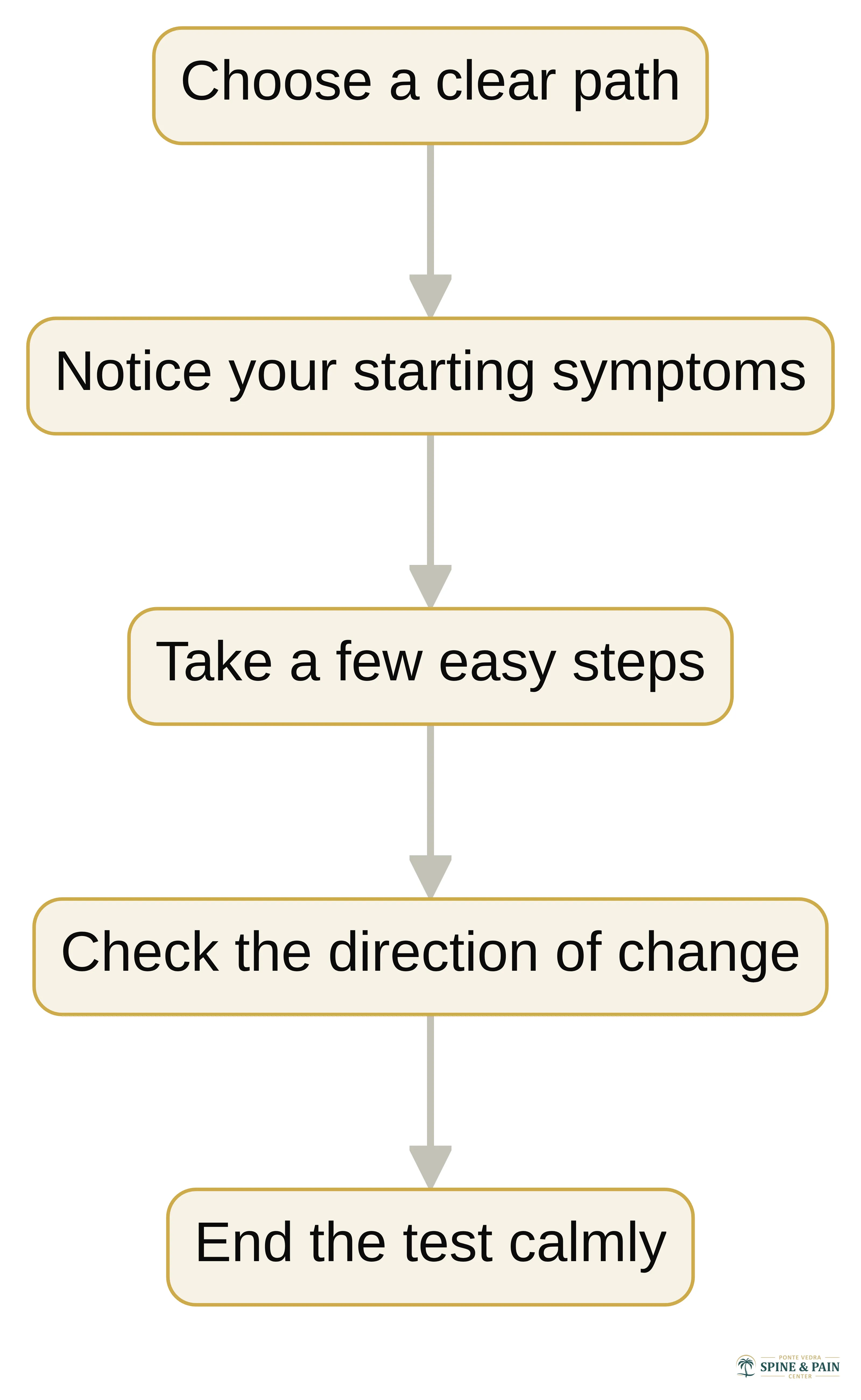
The walking sequence should stay slow enough for you to notice whether symptoms change. Use this order:
- Choose a clear path. Stand in a space where you can walk naturally and turn without a sudden twist. Keep your attention on the movement rather than on reaching a distance.
- Notice your starting symptoms. Before the first step, note where the pain, numbness, or tingling is located. Pay particular attention to whether symptoms already extend below the knee or toward the foot.
- Take a few easy steps. Let your arms move naturally and use a comfortable stride. Do not deliberately arch backward, fold forward, or stretch the painful leg.
- Check the direction of change. Continue only if symptoms stay at the same level or begin to ease. Stop if pain becomes stronger or travels farther down the leg.
- End the test calmly. Stop before you need to force your pace or posture. Notice whether symptoms remain improved, return to their prior level, or continue worsening after you stop.
Pain that spreads farther down the leg during or after a movement intended to ease symptoms is a clear reason to stop that movement. Do not repeatedly restart the walk to see whether the next attempt feels different. A stable or easier response permits you to end the brief walk normally; it does not authorize a longer walk or establish the cause of your symptoms.
After you stop, give yourself a moment to notice the overall direction of your symptoms. You may find that the discomfort is unchanged, temporarily easier, or more widespread. Record that response in plain language rather than assigning it a diagnosis. If symptoms continue worsening after the walk, do not repeat the sequence.
Keep the movement gentle with these form cues
Gentle walking depends more on restraint than on a special posture. Keep these form cues in view:
- Use a small, natural stride. Do not lengthen your steps to create a stronger stretch through the hamstring or buttock.
- Keep your trunk comfortable. Avoid forcing a deep forward bend or a pronounced backward arch. Either direction may aggravate a particular underlying pattern.
- Keep the pace easy. A slower pace gives you time to notice whether leg symptoms are staying in place or moving farther downward.
- Avoid the stretch reflex. Do not turn the walk into repeated leg swings, toe touches, or forceful reaching.
- Let symptoms set the boundary. Comfort during the first few steps does not require you to continue once symptoms change.
These cues are general boundaries, not an individualized exercise prescription. Stretching can worsen sciatica when it puts the nerve under tension or uses a direction that aggravates the underlying condition. Stop rather than trying to correct a painful response by changing your posture repeatedly.
Avoid judging the movement by how much you can tolerate. A longer walk, larger stride, or stronger stretch is not automatically more useful. If you need to brace, limp, hold your breath, or change your posture to continue, finish the trial. Controlled movement is the boundary.
Stop when symptoms intensify or travel farther down the leg
The movement should stop when your symptoms become stronger or move farther down the leg. Pain that travels farther during or after a stretch is described as a signal to stop that movement and try the opposite direction gently; for this walking test, the same symptom boundary means ending the test rather than forcing a different direction.
Stop immediately if you notice any of the following during the walk:
- Pain that becomes clearly more intense.
- Pain that spreads farther toward the calf, foot, or toes.
- A new change in sensation that continues after you stop.
- Difficulty keeping your usual walking pattern.
Sit or stand in a comfortable position after stopping, and do not resume the movement to test your limit. New or worsening neurological symptoms need medical attention rather than additional self-testing.
A worsening response does not prove that walking caused damage or reveal the source of the pain. It only tells you that this movement is not appropriate to continue at that moment. Persistent worsening, substantial weakness, or a new bladder or bowel problem changes the situation and requires prompt medical evaluation.
Once you stop, do not compensate by trying a deeper stretch, a faster pace, or repeated changes of direction. Let the symptoms settle while you remain in a comfortable position. If the worsening response continues, seek medical guidance instead of using more movement trials to find a different answer.
Temporary easing does not treat the underlying cause
Temporary easing means that your symptoms feel less intense during or after the walk; it does not mean that the nerve irritation or compression has been treated. Sciatica may improve with approaches such as stretching, medication, or physical therapy, although severe cases may need additional medical treatment. A brief change after walking cannot tell you which approach belongs in your situation.
The underlying cause matters because sciatica and sacroiliac joint pain can overlap in the lower back, buttocks, and leg while having different causes and treatment approaches. Relief after movement does not distinguish those conditions. Relief also does not show whether symptoms will remain improved after you sit, stand, sleep, or return to your usual activities.
Use the walk for a narrow purpose: to see whether gentle movement feels better than remaining seated. If the movement helps briefly, return to normal activity without turning that improvement into a promise of lasting relief. If the movement aggravates symptoms, stop and arrange evaluation when the pattern persists, recurs, or limits your function.
The response can be useful information without being a conclusion. Temporary relief may help you describe what happened during movement, while renewed symptoms may show that the problem remains. Neither result confirms that the nerve is no longer irritated, identifies a particular spinal structure, or establishes that you should repeat the same movement regularly.
What your response to the movement can and cannot tell you
Your response to easy walking can help you make one immediate decision: continue ordinary movement only while symptoms remain stable or ease, or stop when symptoms intensify or spread. A simple note can make that decision clearer:
- Record where symptoms began and where they were located after walking.
- Note whether pain stayed in the same area, became stronger, or traveled farther down the leg.
- Note whether numbness or tingling changed during the movement.
- Record whether any easing lasted after you stopped, without treating duration as a measure of recovery.
- Write down whether the walk changed your ability to sit, stand, or walk normally afterward.
The movement cannot tell you whether a disc, spinal narrowing, sacroiliac structure, or another condition is responsible. The movement also cannot determine whether you need imaging, medication, physical therapy, an injection, or another treatment. Sciatica can have different causes, and movement direction can aggravate different underlying patterns. Use your notes to describe the symptom pattern during an evaluation, not to assign yourself a diagnosis.
Useful notes focus on function and distribution. Write down whether you could walk normally, whether symptoms reached the foot or toes, and whether the pattern changed after you stopped. This gives a healthcare professional a clearer account of what happened without asking a home movement to answer a diagnostic question.
When persistent or worsening symptoms warrant evaluation
Persistent, recurrent, or worsening sciatica symptoms warrant medical evaluation rather than repeated attempts to find a movement that overrides them. Many people recover with approaches that may include stretching, medication, or physical therapy, but severe cases may need additional medical treatment. A symptom pattern that continues despite ordinary activity deserves a closer assessment of its source.
Arrange a clinical discussion when leg pain, numbness, or tingling keeps returning; when symptoms extend toward the foot or toes and do not settle; or when walking, sitting, sleeping, or ordinary activity becomes harder. These changes do not identify a particular diagnosis, but they make a single home movement an incomplete response. Bring the symptom notes from your walking test so the clinician can hear what changed and what did not.
Do not keep increasing the distance, pace, or intensity to chase temporary relief. Stop the movement if it worsens your symptoms, and seek professional evaluation for a pattern that persists, returns, or interferes with function. The aim is to clarify the problem, not to prove that you can tolerate more activity.
A movement that helps for a few minutes does not remove the need for evaluation when symptoms repeatedly return. Sciatica and sacroiliac joint pain can overlap while requiring different treatment approaches. Ongoing symptoms deserve attention to their pattern, progression, and effect on your daily activities rather than a longer series of home experiments.
Recognize warning signs that require emergency attention
Acute cauda equina syndrome is a medical emergency requiring timely diagnosis and treatment. Red-flag features can include severe low-back pain with sciatica in both legs, numbness in the perineal or genital area, or an inability to pass urine for more than six to eight hours.
Emergency attention is also warranted for new loss of bladder or bowel control, marked weakness in a leg or foot, or rapidly spreading numbness. Delayed evaluation or treatment of acute cauda equina syndrome may lead to permanent neurological or bladder and bowel problems. Do not wait to see whether a walk or stretch changes these symptoms.
Emergency warning signs require emergency medical evaluation, not a longer home exercise routine. If any listed symptom is present, stop the movement and seek immediate care. Act on the warning sign itself rather than waiting for certainty about its cause.
These signs are different from ordinary short-term discomfort during movement. Numbness around the perineal or genital area, difficulty passing urine, loss of bladder or bowel control, severe symptoms affecting both legs, and marked weakness require urgent action. Do not use temporary easing from walking to dismiss them.
Prepare for a focused pain-management discussion near Ponte Vedra Beach
A gentle walk may offer short-term symptom relief, but persistent, recurrent, worsening, or concerning radiating pain calls for a focused evaluation. Bring a concise account of where symptoms travel, what the movement changed, how long any change lasted, and whether numbness, tingling, or weakness appeared. That information can make a pain-management discussion more specific without turning a home movement into a diagnosis.
At Ponte Vedra Spine & Pain Center, we can discuss your symptom pattern and whether professional evaluation is appropriate for ongoing sciatica or radiating nerve pain near Ponte Vedra Beach. A qualified healthcare professional should determine individual suitability for any treatment. Emergency warning signs require immediate medical evaluation rather than a routine appointment.
What should I do if one movement helps only briefly?
What is one movement that may provide temporary relief from sciatica symptoms?
A gentle walking movement may help ease some sciatica symptoms temporarily. It is important to walk at a relaxed pace and stop if symptoms worsen.
How should I perform the walking movement for sciatica relief?
Choose a clear path, notice your starting symptoms, take a few easy steps, and check if your symptoms stay the same or improve. Stop if pain intensifies or spreads.
What should I do if my symptoms worsen during the movement?
If your symptoms become stronger or travel farther down your leg during the walk, stop immediately and do not continue the movement.
When should I seek medical evaluation for sciatica symptoms?
You should seek medical evaluation if your symptoms are persistent, recurrent, or worsening, or if you experience new neurological symptoms such as weakness or loss of bladder control.
What are the warning signs that require emergency medical attention?
Warning signs include severe low-back pain with sciatica in both legs, numbness in the perineal area, or inability to pass urine for more than six to eight hours.
What does temporary relief from walking indicate about my condition?
Temporary relief from walking does not mean the underlying cause of your sciatica has been treated. It only indicates that the movement may have provided brief symptom relief.
How can I prepare for a discussion with a pain-management provider?
Bring a record of your symptoms, including where they travel, any changes during movement, and how long any relief lasted, to facilitate a focused discussion.
Living with this?
We treat this in Ponte Vedra Beach.
Dr. Eli Loch, D.O. — double board-certified in anesthesiology and pain medicine. Reading about it only goes so far; a diagnosis tells you which of these actually applies to you.