
shooting pain
Shooting Pain: How to Map Your Symptoms and Choose the Right Next Step
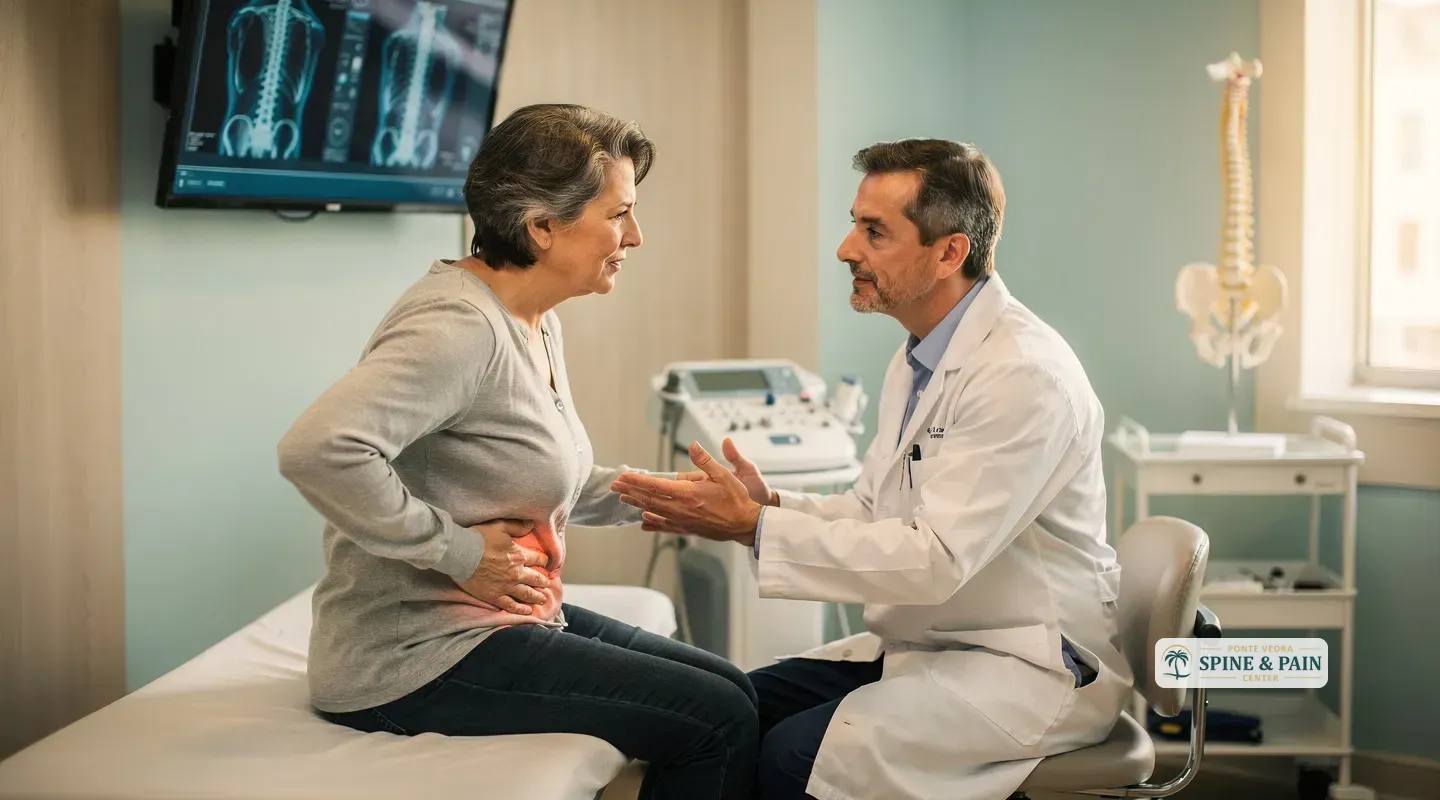
What does shooting pain tell you—and what does it not tell you?
Shooting pain is a symptom pattern, not a diagnosis. Its electric, stabbing, or tingling quality may raise a question about nerve-related pain, but the sensation alone cannot identify what is causing it.
Neuropathic pain can be mild or severe, come and go, or linger. Damaged nerve fibers can send abnormal signals to pain centers, and nerve function can change at the site of damage or in parts of the central nervous system. Those mechanisms help explain why the same broad description can occur in different medical situations; they do not tell you which situation applies to you.
At Ponte Vedra Spine & Pain Center, we treat lower back pain and sciatica, but a symptom label does not establish that either condition is the source of your pain. An evaluation connects the symptom pattern with your history and examination before a treatment discussion begins.
A symptom map gives you a more useful way to describe what is happening than a single pain score. Record these details:
- Where the pain begins and where it travels.
- Whether it feels electric, stabbing, tingling, burning, or different from your usual ache.
- How often it appears and how long each episode lasts.
- Whether you notice weakness, numbness, or tingling.
- What the pain changes in your walking, sitting, sleeping, work, or other daily activities.
- What treatments you have already tried and what happened afterward.
A structured neuropathic pain assessment can ask about electric-shock, stabbing, and tingling pain, along with frequency and duration. One cited symptom inventory uses 10 descriptor items, two items about frequency and duration, an 11-point rating scale, and a recall period covering the previous 24 hours. You do not need to recreate that inventory at home. Use its basic logic: describe the quality, route, timing, and effect of the symptom clearly.
The goal is not to give yourself a label. The goal is to bring a clear account of the pattern to a conversation about back and spine pain.
Build a symptom map from the pain’s quality and route
A symptom map becomes more useful when you pair the pain’s quality with its route. Write down whether the sensation stays near your back or moves into an extremity, and note the exact path as closely as you can. Describe what you feel rather than assigning yourself a diagnosis.
Electric-shock, stabbing, and tingling sensations are descriptors used in neuropathic pain assessment. Radiculopathy describes symptoms produced by pinching of a nerve root in the spinal column; depending on its location, it can include pain, weakness, numbness, and tingling. A route that seems nerve-related is therefore a reason to discuss nerve symptoms during an evaluation, not proof that a particular nerve root is involved.
The route also needs context. Note whether the sensation stays in one place, travels along one side, changes with time, or appears with numbness or weakness. Avoid treating a familiar route as a diagnosis. Similar descriptions can require different questions and different examinations.
Use a short entry each time the pattern changes. For example, record the starting point, the path, the quality, the duration, and what you were doing when it began. If the sensation travels from the lower back into the hip or leg, describe that route in ordinary words rather than trying to name the nerve involved.
Ponte Vedra Spine & Pain Center offers image-guided injections, but the path of your symptoms does not by itself establish that an injection is suitable. The route helps organize the discussion about whether your symptoms may involve a nerve root, a joint, or another structure that needs assessment.
A useful record can also show whether the sensation is always present or appears in episodes. That distinction does not diagnose the source, but it gives the evaluation a clearer starting point. Bring the route you have recorded to an appointment and keep the cause open until the clinical findings are reviewed.
Use spine-related patterns as questions, not self-diagnoses
Radiculopathy is a term for symptoms produced by pinching of a nerve root in the spinal column. Sciatica is usually caused by compression of a nerve root that contributes to the sciatic nerve; L5 and S1 are commonly involved roots as they exit the spine, and the medical term for this condition is radiculopathy.
These definitions can help you ask better questions. You might ask whether the location, route, numbness, tingling, or weakness could fit a nerve-root pattern. You should not conclude that a disc, stenosis, or another structure is responsible based only on the path of your pain. A symptom pattern narrows a conversation; it does not finish the evaluation.
Radiculopathy can be associated with narrowing where nerve roots leave the spine. Stenosis, bone spurs, and disc herniation are among the conditions associated with that narrowing. The same finding may not explain your symptoms unless it matches your history and examination.
Ponte Vedra Spine & Pain Center treats sciatica and lower back pain. That service scope gives you a local place to discuss a suspected pattern, not a reason to label the cause before you are evaluated.
A useful note might say, “The pain begins in my lower back and travels down one side,” followed by the quality, timing, and accompanying symptoms. A less useful note would say only, “I have a pinched nerve.” Use the first description. It preserves the information a clinician needs while leaving the diagnosis open.
You can also separate what you know from what you suspect. “The pain reaches my calf” is an observation. “A herniated disc is pressing on a specific nerve” is a conclusion that requires clinical assessment. Keeping those statements separate helps prevent a familiar pattern from narrowing the conversation too early.
Add timing and neurologic changes to the map
Timing gives the symptom map another layer of meaning. Record when the pain began, whether it appears in episodes or remains present, how long each episode lasts, and whether the pattern has changed. Neuropathic pain may come and go or linger, and it can range from mild to severe, so duration and frequency belong beside intensity rather than afterthoughts.
Record neurologic changes separately from pain. Note numbness, tingling, or weakness, including whether a change is new, increasing, or present only during an episode. Radiculopathy can include pain, weakness, numbness, and tingling, but those symptoms do not identify the cause by themselves.
Function adds practical meaning. Write down whether the symptom changes your ability to sit, stand, walk, sleep, work, or complete ordinary tasks. A clinician can then consider the symptom’s effect rather than hearing only a number from zero to ten.
A simple record can use six columns:
- Quality: electric, stabbing, tingling, burning, aching, or another description.
- Location and route: where it starts and where it travels.
- Timing: when it began, how often it occurs, and how long it lasts.
- Neurologic changes: weakness, numbness, or tingling.
- Functional effect: changes in walking, sitting, sleeping, work, or other tasks.
- Prior care: what you tried and what happened afterward.
A structured neuropathic pain inventory uses 10 descriptor items, two items for frequency and duration, an 11-point rating scale, and a previous-24-hours recall period. You can use that structure as a communication aid without treating it as a diagnostic test. At Ponte Vedra Spine & Pain Center, this kind of detail can make a discussion about image-guided injections, nerve stimulation, or another pain-management option more specific, while the evaluation still determines what belongs in the discussion.
Use the record as a before-and-after comparison when the pattern changes. Keep the earlier route, quality, timing, neurologic changes, and functional effect beside the newer entry, then mark only what is different. For example, the pain may travel farther, occur more often, or appear with a new change in strength or sensation. Those observations help you report change precisely; they do not establish whether a nerve root, disc, joint, or another structure is responsible. This comparison also keeps a new concern from being buried inside an older average pain score.

Which changes make evaluation more important?
Certain changes make professional medical evaluation more important than choosing a routine treatment discussion from symptoms alone. Serious warning signs include:
- Major or progressive weakness or loss of sensation.
- New bowel or bladder incontinence or urinary retention.
- Loss of anal sphincter tone or numbness in the saddle area.
- A history of cancer that has spread to bone.
- Suspected spinal infection.
- Significant trauma related to your age or possible osteoporosis.
These signs do not tell you the diagnosis, but they change the level of concern. If any apply to you, seek prompt medical attention rather than waiting to select an injection, radiofrequency ablation, or another elective option.
An evaluation for chronic low back pain can include a history and physical examination for red flags, yellow flags, and radicular symptoms. Routine imaging is not recommended, but imaging is indicated when red flags, a neuromuscular deficit, or pain that persists after conservative therapy is present.
Ponte Vedra Spine & Pain Center offers image-guided injections and other pain-management options, but those services do not replace assessment of warning signs. A concerning change should move the focus to medical evaluation first. Do not use a temporary change in pain as proof that a serious condition is absent.
If none of these warning signs applies, that still does not identify the cause. It simply leaves room for a planned evaluation that considers the pattern, duration, function, previous care, and examination findings together.
Use a separate warning-sign checkpoint before a routine option discussion. Review whether any change is new or progressive, and whether significant trauma is part of the history, rather than folding those details into a general pain score. If a listed warning sign is present, the next step is prompt medical attention; if none is present, that does not select a procedure or rule out the value of an evaluation. It keeps the safety question separate from the treatment-choice question.
What will a clinician need to know beyond the pain score?
A clinical evaluation needs more than an intensity score. Prepare to explain where the pain starts, where it travels, what it feels like, when it began, how often it occurs, how long it lasts, and whether numbness, tingling, or weakness accompanies it. Include the effect on your daily function and the care you have already tried.
The history and physical examination can assess red flags, yellow flags, and radicular symptoms. A symptom assessment can also ask about electric-shock, stabbing, and tingling qualities, frequency, and duration. These details help organize the discussion without turning any single answer into a diagnosis.
To make the visit easier to follow, separate your notes into three headings: what you feel, what it changes, and what you want clarified. Put location, route, quality, timing, and neurologic changes under what you feel; put walking, sitting, sleep, work, or other task changes under impact; put questions about the suspected source, examination, imaging, or options under what you want clarified. Keep a suspected diagnosis in the question column rather than presenting it as an established fact. That format preserves the distinction between an observation and a clinical conclusion.
Chronic low back pain means lumbar pain that has persisted for 12 weeks or more. Chronic low back pain occurs in about 13% of U.S. adults. If your symptoms have lasted that long, write down the date or approximate period when they began and describe how the pattern has changed.
Before an appointment, prepare a short answer to each of these questions:
- Where does the symptom start, and where does it travel?
- Is the quality electric, stabbing, tingling, burning, or something else?
- Does it stay present, or does it come and go?
- When did it begin, and has its frequency or route changed?
- Have you noticed weakness, numbness, or tingling?
- What activities, positions, or daily tasks are affected?
- What care have you already tried, and what happened afterward?
- What do you want the evaluation to clarify?
This preparation is useful even if your answers are incomplete. A changing symptom pattern can be described as a change. You do not need to decide whether a disc, nerve root, facet joint, or another structure is responsible before asking for an evaluation.
Imaging is not an automatic first step for every case. Routine imaging is not recommended, while imaging is indicated when red flags, a neuromuscular deficit, or persistent pain after conservative therapy is present. Ask what the examination is intended to clarify and whether imaging would change the next decision.
If you already have prior imaging information, include the date and the main finding in your notes rather than assuming it explains the pain. A scan showing a disc or narrowing does not, by itself, establish that finding as the source of your symptoms. At Ponte Vedra Spine & Pain Center, the discussion can include your prior care, functional effect, and goals before image-guided injections or other options are considered.
What should you record before discussing shooting pain?
Before a pain management evaluation, write an episode note rather than a theory about the cause. Choose one recent instance of shooting pain and describe it in ordinary words: where it began, where it traveled, what it felt like, and whether it came and went or lingered.
Terms such as electric-shock, stabbing, burning, and tingling give the note descriptive detail. Add when the pattern began and note weakness or numbness separately. Include any care you’ve already tried. A neuropathic pain assessment can ask about these descriptors, frequency, and duration, but an episode note doesn’t identify the source.
Keep the note for a conversation with Ponte Vedra Spine & Pain Center in Ponte Vedra Beach. Its purpose is to preserve your description so it can be considered with a history and physical examination.
Ponte Vedra Spine & Pain Center offers radiofrequency ablation, but an offered procedure is not a recommendation for every person with back pain. The useful question is not which procedure has the most familiar name. The useful question is what your evaluation supports discussing and what conditions apply.
Use this sequence when you prepare for the conversation:
- Describe the symptom pattern without naming its cause.
- Identify changes in strength, sensation, or function.
- Explain how long the pattern has been present and what care you have tried.
- Ask what the examination suggests about the source.
- Ask how a proposed option relates to that source and what alternatives remain.
Bring three answers to that conversation: what you feel, what the examination needs to clarify, and what care you have already tried. If conservative care is part of the discussion, ask how it relates to the suspected source and what would prompt a different conversation. Keep the boundary clear: a general option list cannot determine individual suitability.
Which pain-management options may be discussed at Ponte Vedra Spine & Pain Center?
Your symptom map should shape the questions, not select a procedure. Bring the route, quality, timing, neurologic changes, functional effect, and previous care to the evaluation so the discussion can stay connected to the suspected source and examination findings.
Our pain-management options at Ponte Vedra Spine & Pain Center include image-guided injections, radiofrequency ablation, nerve stimulation, and regenerative therapy. These are pain-management categories for clinical discussion, not conclusions drawn from the words “shooting pain.” An offered service does not establish suitability or a particular result.
For any option, ask what suspected source or finding it is meant to address, how previous care affects the discussion, and which alternatives should be compared. The cited facet evidence applies to facet-mediated pain; it does not apply automatically to every shooting-pain pattern. That distinction is why the symptom map comes before the option list.
The same symptom can lead to different treatment questions. Facet-mediated pain has its own evidence about nerve blocks and radiofrequency ablation, while a nerve-root pattern may require a different evaluation. An injection category also contains different procedures, including epidural injections, facet and medial branch blocks, joint injections, and nerve blocks.
Use your map to ask what the proposed option is meant to address. Ask which finding connects it to your symptoms, what prior care matters, and whether the discussion concerns diagnosis, treatment, or both. Ponte Vedra Spine & Pain Center can discuss the options we offer after the clinical context is established; no option should be inferred from the phrase “shooting pain” alone.
An option list is most useful when you treat it as a set of questions. It can help you understand what may be discussed without asking you to choose a procedure before an evaluation.

Where do nerve stimulation and regenerative therapy fit?
Some changes make prompt professional attention more important than a routine option discussion. Serious red flags include major or progressive motor or sensory deficit, new bowel or bladder incontinence or urinary retention, saddle anesthesia, suspected spinal infection, a history of cancer metastatic to bone, or significant trauma related to age or possible osteoporosis. Don’t use a shooting-pain label to explain these changes away.
For other situations, nerve stimulation still requires a clinical discussion. We use spinal cord stimulation for persistent nerve pain, including pain after previous disc surgery. That service description identifies an offered setting; it does not establish that your symptoms meet those conditions.
Before asking about nerve stimulation, bring the map and state what you want clarified: the pattern, the function it affects, and the care you’ve already tried. This keeps a service description from becoming a diagnosis or a selection rule.
Ponte Vedra Spine & Pain Center offers regenerative therapy for spine, nerve, and joint pain. Its role should be connected to the suspected source, examination findings, duration, functional effect, prior care, and goals before it is compared with conservative care, a targeted injection or nerve block, nerve stimulation, or radiofrequency ablation.
That sequence matters because regenerative therapy is a category, not a diagnosis. Bring the same symptom map to this discussion: location, route, quality, timing, neurologic changes, functional effect, and prior treatment. The treatment conversation should remain tied to the findings and conditions that apply to you. No offered category promises a particular outcome.
You can ask what clinical question a proposed regenerative therapy is meant to address, how your prior care affects that discussion, and which other options may be considered. Those questions keep the conversation specific without treating the service category as a conclusion.
What should you bring to a local shooting-pain evaluation?
A focused appointment starts with a focused record. Bring or write down:
- The place where the pain starts and the route it follows.
- The words that describe it, such as electric, stabbing, or tingling.
- When it began, how often it occurs, and how long episodes last.
- Any weakness, numbness, or tingling, including changes over time.
- What it changes in your walking, sitting, sleep, work, or other daily activities.
- Previous treatments, procedures, therapy, medications, or evaluations and what happened after each.
- Your main goal for the discussion and the question you want answered.
This record gives an evaluation more than a single intensity score. It also keeps the discussion anchored to function and prior care. The history and examination can then address red flags, yellow flags, and radicular symptoms, with imaging considered selectively when the clinical conditions support it.
Ponte Vedra Spine & Pain Center treats lower back pain and sciatica and is located at 380 Town Plaza Ave, Suite 420, Ponte Vedra Beach, FL 32081.
If you live in Ponte Vedra Beach, Nocatee, the Jacksonville Beaches, or St. Johns County, include the practical details that affect your visit and the pain-management discussion. Your location does not change the medical assessment, but a clear local plan can make it easier to bring your symptom notes and describe the effect of symptoms on your normal routine.
Before you request an appointment, make sure your notes distinguish the symptom itself from your theory about its cause. That small distinction can keep the first conversation focused on what you actually experience, what has changed, and what needs to be clarified.
How can you request the next discussion?
Request an evaluation with Ponte Vedra Spine & Pain Center when you want to discuss shooting pain before considering a procedure. Before you submit the appointment request, summarize where the pain starts and travels, how it feels, when it began, how often it occurs, any weakness, numbness, or tingling, its effect on function, and treatments you’ve already tried.
Our appointment request form includes your name, email, phone, preferred time, insurance, clinic, referral source, and notes. Use the notes to give us the short version of your map and the question you want answered. The center is at 380 Town Plaza Ave, Suite 420, Ponte Vedra Beach, FL 32081.
We can discuss image-guided injections, radiofrequency ablation, nerve stimulation, and regenerative therapy after the clinical context is established. The request starts that discussion; it does not choose an option in advance.
What should you ask before an evaluation for shooting pain?
What is the medical term for shooting pain?
There isn’t one medical term that explains every episode. Shooting, electric-shock, stabbing, burning, and tingling are symptom descriptions often assessed when neuropathic pain is possible, but they don’t identify the cause.
What should I do if shooting pain comes with weakness or bladder changes?
Seek prompt medical attention rather than waiting to choose a routine pain-management procedure. Major or progressive weakness, new bladder incontinence or urinary retention, saddle-area numbness, significant trauma, suspected spinal infection, or a history of cancer that has spread to bone are serious warning signs. These symptoms require medical evaluation before discussing options such as injections or radiofrequency ablation.
Can a pain specialist evaluate shooting pain when I don't know the cause?
Yes. You don’t need to diagnose yourself before an evaluation. Bring the pain’s location and route, its quality and timing, any numbness or weakness, changes in function, and previous treatments. Ponte Vedra Spine & Pain Center can use that history and examination to discuss whether image-guided injections, radiofrequency ablation, nerve stimulation, regenerative therapy, or another approach belongs in the conversation.
Living with this?
We treat this in Ponte Vedra Beach.
Dr. Eli Loch, D.O. — double board-certified in anesthesiology and pain medicine. Reading about it only goes so far; a diagnosis tells you which of these actually applies to you.